Technical Principles of Lattice Structures
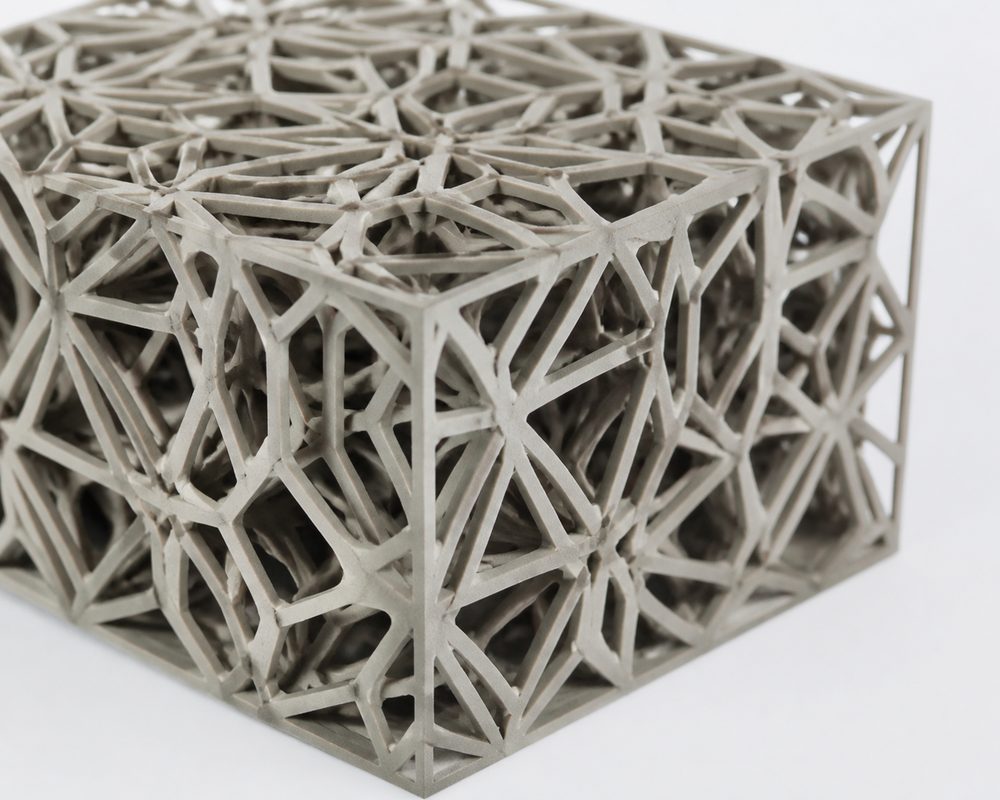
Lattice structures are three-dimensional porous structures composed of periodic or aperiodic unit cells, with design inspiration derived from natural porous materials such as honeycombs, bones, and wood. Compared to traditional solid structures, lattice structures can reduce weight by 50%–90% while maintaining high stiffness and strength. This characteristic gives lattice structures immense application potential in fields such as aerospace, automotive manufacturing, and medical devices; especially in weight-sensitive fields, lattice structures are almost the only choice.
From a mechanical perspective, the performance of lattice structures depends on three factors: the geometry of the unit cell, the dimensions of the unit cell (strut diameter, pore size), and the arrangement of unit cells. Different unit cell shapes possess distinct mechanical characteristics—some excel at withstanding compressive loads (e.g., honeycomb structures), some excel at withstanding shear loads (e.g., octet structures), while others exhibit balanced performance under multi-directional loads (e.g., gyroid structures). By rationally selecting and combining unit cells, tailored mechanical properties can be achieved to meet the requirements of specific applications.
Comparison of Common Lattice Types and Characteristics
Currently, there are over 50 types of commonly used lattice unit cells, with common examples including: Honeycomb, Octet, Gyroid, Diamond, Body-Centered Cubic (BCC), and Face-Centered Cubic (FCC) structures. The honeycomb structure is the simplest two-dimensional lattice, composed of hexagonal units; it possesses excellent in-plane compression performance and is frequently used in lightweight panel design. The octet structure consists of connecting struts, exhibiting uniform mechanical properties in three directions, making it suitable for multi-directional loading applications.
The Gyroid structure is a type of Triply Periodic Minimal Surface (TPMS) structure. Its surface is smooth and continuous without sharp nodes, resulting in uniform stress distribution and excellent fatigue performance. The Diamond structure consists of interconnected struts, possessing high stiffness and strength, but exhibits significant stress concentration. BCC and FCC structures are the simplest 3D lattices, composed of diagonal struts; they have low printing difficulty but relatively weak mechanical properties. When selecting a lattice type, factors such as loading type, performance requirements, and printing difficulty need to be comprehensively considered.
Topology Optimization and Lattice Infilling
Topology Optimization is an important tool for lattice structure design. The goal of topology optimization is to find the optimal distribution of materials within a given design space through mathematical algorithms, enabling the structure to achieve optimal performance (such as minimum compliance or maximum stiffness) under specific constraints (such as weight limits or displacement limits). The result of topology optimization is typically a "density distribution map" that shows which regions require material and which regions can have material removed.
Combining topology optimization results with lattice structures enables "variable density lattice" design—utilizing high-density lattices with large strut diameters in high-stress regions and low-density lattices with small strut diameters in low-stress regions, thereby achieving optimal material utilization. Currently, mainstream CAD software (such as SolidWorks, Fusion 360, and nTopology) offers both topology optimization and lattice infill capabilities. For example, nTopology can automatically adjust lattice parameters based on field variables (such as stress or temperature) to generate highly customized lattice structures. This "adaptive lattice" design method is becoming a mainstream trend in lightweight design.
Prediction of Mechanical Properties of Lattice Structures
Predicting the mechanical properties of lattice structures is a major challenge in design. Due to the complexity of lattice structures, traditional Finite Element Analysis (FEA) requires extremely fine meshes, resulting in massive computational costs. Currently, common prediction methods include: Homogenization Theory, empirical formula methods, and machine learning prediction. Homogenization Theory treats periodic lattice structures as equivalent homogeneous materials, significantly reducing computational complexity by calculating parameters such as equivalent elastic modulus and equivalent Poisson's ratio.
The empirical formula method establishes the relationship between the relative density of a lattice and its mechanical properties based on extensive experimental data. For instance, for many strut-based lattices, the relative elastic modulus (E/E_s) and the relative density (ρ/ρ_s) follow a power-law relationship: E/E_s = C(ρ/ρ_s)^n, where C and n are material constants. Machine learning methods, in contrast, establish a nonlinear mapping relationship between lattice geometric parameters and mechanical properties by training neural networks; these methods offer fast prediction speeds and high accuracy but require a large amount of training data. Regardless of the method employed, experimental validation is ultimately required to ensure the accuracy of the predictions.
Process Constraints and Manufacturability Analysis
The design of lattice structures must consider process constraints, otherwise it may lead to printing failures or substandard quality. First is the minimum strut diameter limit, as the minimum printable strut diameter varies by process: FDM processes are typically not less than 0.8-1.0 mm, SLA/DLP processes not less than 0.3-0.5 mm, SLS processes not less than 0.7-1.0 mm, and SLM metal printing not less than 0.3-0.5 mm. Excessively small strut diameters can lead to discontinuous printing or insufficient strength. Second is the overhang angle limit; inclined struts and nodes in lattice structures often form overhangs, requiring supports or design as self-supporting structures.
In SLM metal printing, lattice structures also face the issue of "powder residue"—unsintered powder may remain inside fine lattice cells, which not only increases the weight of the part but may also affect its performance and operational safety. Solutions include: 1) designing "drainage holes" to allow powder to flow out; 2) adopting "self-supporting" lattice designs to reduce powder accumulation; and 3) removing residual powder through ultrasonic cleaning or high-pressure gas blowing after printing. Furthermore, the surface roughness of lattice structures can affect their fatigue performance, necessitating appropriate post-processing (such as sandblasting or polishing).
Case Analysis of Lightweight Design
The aerospace field is a typical application scenario for the lightweighting of lattice structures. Taking an aircraft seat bracket as an example, a traditional aluminum alloy bracket weighs approximately 800g. Through topology optimization and lattice infill design, the weight can be reduced to 350g, achieving a 56% weight reduction while increasing stiffness by 15%. The design process includes: 1) determining the design space and load conditions; 2) performing topology optimization to obtain material distribution; 3) filling the optimized region with BCC lattice, with a strut diameter of 1.0mm and a porosity of 70%; 4) verifying performance through Finite Element Analysis (FEA); 5) printing the prototype and testing. The final product has passed airworthiness certification and has been put into commercial use.
In the field of medical devices, lattice structures are used to manufacture orthopedic implants. Traditional titanium alloy implants are solid structures with an elastic modulus far higher than that of human bone, easily leading to the "stress shielding" effect. By designing porous titanium alloy lattice structures, the elastic modulus of implants can be adjusted to a range matching that of human bone (10-20 GPa), promoting bone tissue healing. For instance, a spinal fusion cage made of Ti-6Al-4V material and filled with a Gyroid lattice features a porosity of 80% and an elastic modulus of 12 GPa, demonstrating clinical efficacy significantly superior to traditional solid implants. This "biomechanical matching" design represents a unique advantage of lattice structures in the medical field.
Testing and Verification of Lattice Structures
Testing and verification of lattice structures is more complex than that of traditional structures. In addition to conventional tensile, compression, and bending tests, attention must also be paid to the specific properties of lattice structures, such as energy absorption capacity, fatigue performance, and impact performance. Compression testing is the most commonly used method for testing lattice structures. The compression curve reveals the elastic, plateau, and densification stages of the lattice, allowing for the evaluation of its energy absorption capacity. For protective applications (such as helmet liners and buffers), energy absorption capacity is a key indicator.
Fatigue testing is particularly important for dynamic loading applications. The fatigue performance of lattice structures is typically lower than that of solid materials due to stress concentration at the junctions of nodes and struts. Methods to improve fatigue performance include: 1) using lattice types with smooth transitions (such as Gyroid) to reduce stress concentration; 2) polishing the lattice surface to remove micro-cracks and defects; 3) adding a thin shell layer to the lattice surface to protect the lattice structure. Furthermore, testing of lattice structures requires consideration of the "size effect"—test results from small-scale specimens may not represent the performance of large-scale structures, necessitating multi-scale verification.
Recommended Design Software and Tools
Currently, the market offers a variety of software supporting lattice structure design, ranging from simple plugins to professional lattice design platforms, with significant differences in functionality. For beginners, Fusion 360's lattice fill capability is sufficient, allowing for the generation of simple lattice structures based on voxels or meshes. For professional users, nTopology (now rebranded as nTop) is currently the most powerful lattice design software, supporting advanced features such as field-based adaptive lattice generation, TPMS structure design, and lattice-solid hybrid design. Altair Inspire serves as a benchmark software in the field of topology optimization and integrates seamlessly with various CAD software.
For metal 3D printing, Materialise Magics offers a professional lattice design module that supports a complete workflow including lattice infill, support generation, and slicing for STL files. Dassault Systèmes' 3DEXPERIENCE platform also integrates lattice design capabilities, supporting the entire workflow from design to simulation. In terms of open-source tools, Python libraries such as PyVista and Trimesh can be used to programmatically generate lattice structures, making them suitable for scenarios requiring batch generation or custom development. Regardless of the tool chosen, it is necessary to align with actual application requirements and engage in sufficient learning and practice.
Future Development Trends
The future development of lattice structure technology will revolve around three directions. The first is "multi-scale lattice" design, which involves nesting micro-lattices within macro-lattices to achieve a gradient variation in material properties. This structure can mimic biological materials found in nature (such as bone and wood), realizing different functions at different scales. The second is the integration of "4D printing" with lattice structures, utilizing shape memory materials or stimuli-responsive materials to enable lattice structures to change shape or properties under external stimuli (such as temperature, humidity, or magnetic fields), thereby realizing smart structures.
Finally, there is "AI-driven lattice design," which utilizes deep learning algorithms to automatically generate optimal lattice structures based on load conditions, performance requirements, and process constraints. This approach can overcome the experiential limitations of human designers and discover novel lattice configurations. For example, recent research indicates that lattice structures designed using Generative Adversarial Networks (GANs) exhibit a stiffness increase of more than 30% compared to traditional lattices at the same weight. As these technologies mature, lattice structures will play an important role in more fields, becoming one of the core technologies for lightweight design.
Submit a model, drawing, image or written notes. Engineers will review material, process, finishing and delivery based on actual use.