Optimal design of 3D printing support structure: angle calculation, support type selection and removal techniques
Excellent 3D printing design is half the battle. Optimal design of 3D printing support structure: angle calculation, support type selection and removal skills are core skills that every designer and engineer must master, which directly affect printing success rate, part quality and production cost.
Design principles and theoretical basis
There are fundamental differences in design concepts between 3D printing and traditional manufacturing processes. Traditional manufacturing is limited by molds, cutting tools and assembly processes, and the degree of design freedom is limited; 3D printing can achieve almost any complex geometric shape, providing a broad space for design innovation. However, this degree of freedom is not without limitations - factors such as support structures, suspension angles, thermal stresses, etc. still restrict the feasibility of the design.
Understanding the molding principles of 3D printing is the basis for optimized design. The FDM process is formed by layer-by-layer accumulation, and the interlayer bonding force is weak, and the Z-direction strength is usually only 30-50% of the XY direction; the SLA process is formed by light curing, which has good isotropy, but has curing shrinkage problems; the SLS process is formed by powder sintering, and the parts are wrapped in unsintered powder without support, but the surface roughness is high.
Detailed explanation of key design parameters
In 3D printing design, the following parameters require special attention:
Wall Thickness: Too thin a wall will cause the part to be fragile or even impossible to print, while too thick a wall will waste material and increase thermal stress. Different processes have different minimum wall thickness requirements: FDM is about 1.0-1.5mm, SLA is about 0.8-1.0mm, SLS is about 1.0-1.5mm, and metal printing is about 1.5-2.0mm.
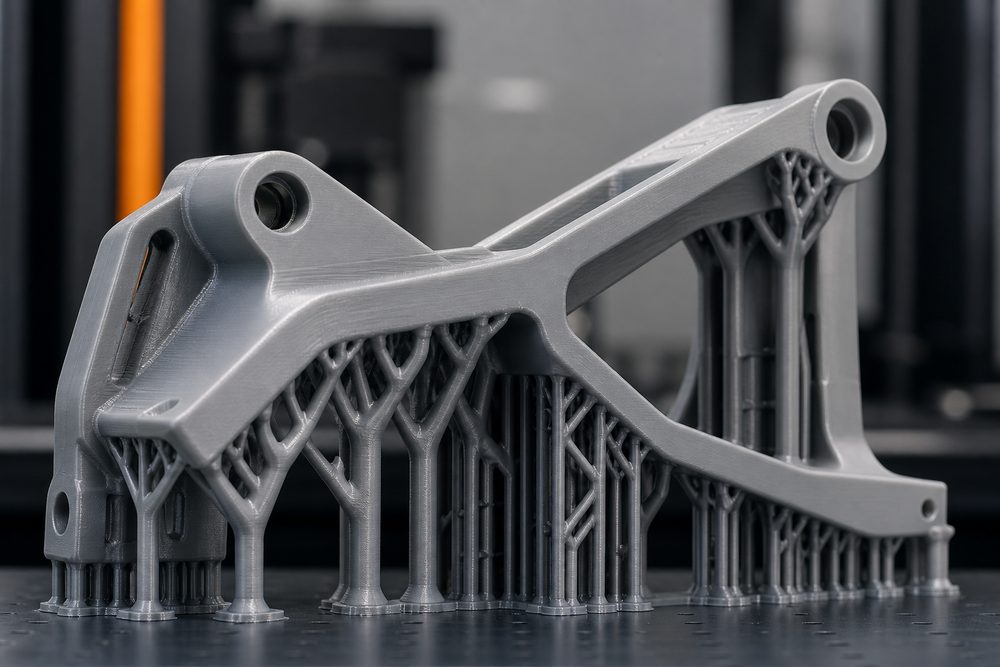
Overhang angle: Most 3D printing processes require support structures to print overhanging parts. The general rule of thumb is: suspension angles less than 45° require support; less than 30° may require support, depending on materials and equipment; greater than 45° can usually be self-supporting.
Rounds and chamfers: Sharp internal and external corners are prone to stress concentration, leading to warping or cracking. It is recommended that all internal corners be rounded at least 0.5mm and external corners be chamfered or rounded at least 0.3mm.
Common design errors and corrections
The following are common errors and correction solutions in 3D printing design:
Mistake 1: Ignoring support requirements. Deep cavities, cantilevers, and steeply inclined surfaces all require support. Correction: Redesign the geometry, add support structures, or adjust the printing direction.
Mistake 2: Uneven wall thickness. Excessive wall thickness difference leads to uneven cooling and warping deformation. Correction: Try to keep the wall thickness as uniform as possible, or use stiffeners instead of thick walls.
Mistake 3: Unreasonable tolerance design. The accuracy of 3D printing is usually ±0.1-0.3mm, and sufficient clearance needs to be reserved for the assembly. Correction plan: Reserve 0.2-0.3mm gap for active fit, 0.05-0.1mm for transition fit, and use interference fit with caution.
Error 4: Ignoring post-processing. Post-processing such as support removal, sanding, painting, etc. can alter the final dimensions. Correction plan: Reserve a margin for post-processing during the design stage, or choose a process that does not require post-processing.
Design Checklist
Before submitting for 3D printing, it is recommended to check according to the following checklist:
✓ Does the minimum wall thickness meet the process requirements?
✓ Does the hanging angle require support? Are supports easy to remove?
✓ Are assembly clearances sufficient? Are features such as threads and snaps printable?
✓ Is the part orientation optimized? Is the critical surface facing up?
✓ Do you need to add structural features such as ribs and fillets?
✓ Have typesetting and support sharing been considered when printing in batches?
Advanced design technology
With the development of 3D printing technology, some advanced design technologies have gradually matured:
Topology optimization: Automatic structural optimization based on finite element analysis, minimizing material usage and achieving lightweight design while meeting performance requirements.
Generative design: An AI-based design method that automatically generates a variety of design options for selection based on performance goals and constraints.
Lattice structure: Internally filled lattice structure greatly reduces weight while maintaining stiffness, especially suitable for aerospace and biomedical applications.
Summary
Optimal design of 3D printing support structures: angle calculation, support type selection and removal techniques require a combination of theoretical knowledge and practical experience. The design team of lantu3D has rich experience in 3D printing design and can provide customers with full-process services from design optimization to production and manufacturing, ensuring that every design can be perfectly realized.
Submit a model, drawing, image or written notes. Engineers will review material, process, finishing and delivery based on actual use.