Introduction: Design freedom and functional value of porous structures
One of the core advantages of 3D printing technology is the realization of complex geometric structures that cannot be achieved by traditional manufacturing processes. Porous Structure is one of the most representative applications. By introducing regular or irregular pores into solid materials, porous structures can significantly reduce weight while maintaining structural strength, and at the same time give parts special functions such as ventilation, filtration, energy absorption, and heat exchange. From lightweight stents in aerospace, to human implants in medical devices, to filter elements in the chemical industry, porous structures are redefining the boundaries of possibility in part design.
Compared with traditional manufacturing processes (such as casting and machining), 3D printing has significant advantages in manufacturing porous structures. Traditional processes for manufacturing porous structures usually rely on methods such as foaming, sintering, or chemical etching. The porosity, pore diameter, and pore shape are difficult to precisely control, and the structural consistency is poor. 3D printing can precisely control the geometric characteristics of pores through parametric design, achieving any design from micron level to millimeter level pore diameter, and has excellent batch consistency. This article will systematically introduce the design method, process selection, performance characterization and application scenarios of 3D printed porous structures, providing engineers with practical design guidelines.
Classification and geometric characteristics of porous structures
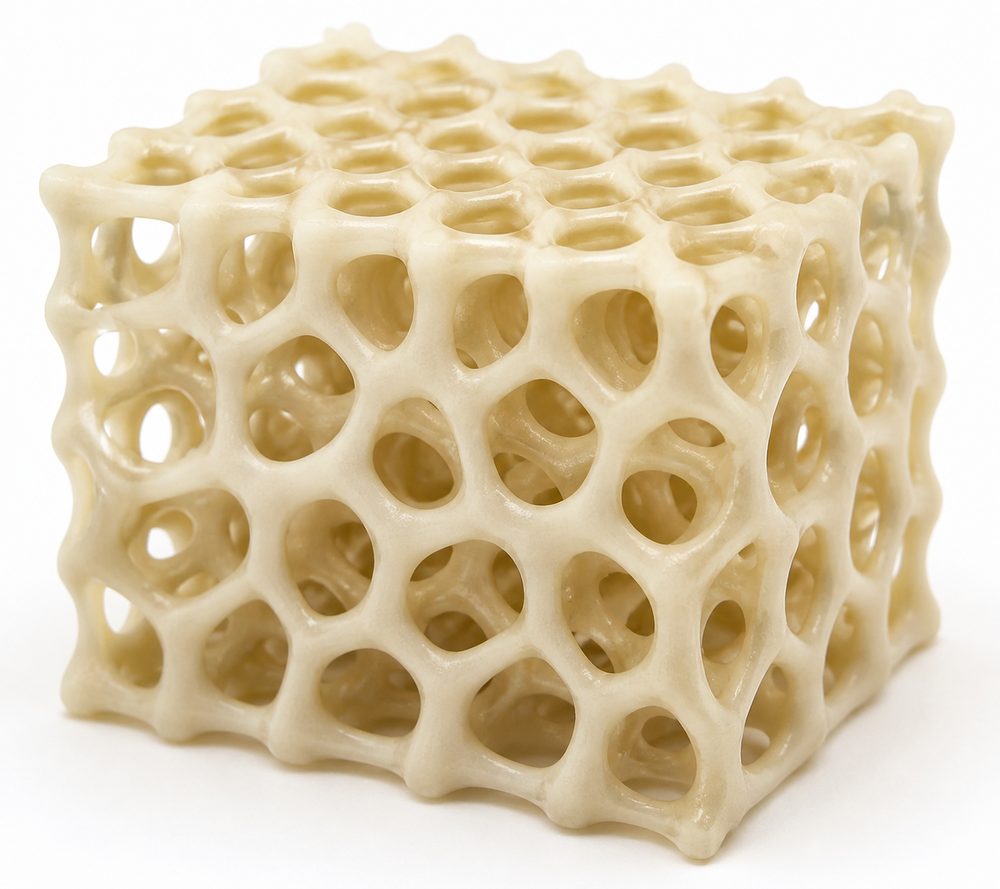
Based on the arrangement of pores, porous structures can be divided into two categories: regular porous structures and random porous structures. Regular porous structures (such as honeycomb structures and lattice structures) have periodically arranged pore units, and the pore shape, pore diameter and porosity can be precisely designed. Common regular porous structures include cubic lattice, body-centered cubic (BCC), face-centered cubic (FCC), diamond lattice, gyroscope lattice, etc. Each of these structures has its own characteristics: the BCC lattice has good isotropy and is suitable for bearing multi-directional loads; the diamond lattice has a large specific surface area and is suitable for filtration and catalytic applications; the gyroscope lattice has an excellent stiffness-to-weight ratio and is suitable for lightweight design.
Random porous structures simulate porous materials in nature (such as bones and sponges). The pore distribution and connectivity are random, but the statistical characteristics are controllable. Random porous structures are usually generated through algorithms, such as Voronoi partitioning, Perlin noise, random ball packing, etc. The advantage of this type of structure is that it is closer to the mechanical behavior of natural materials and can avoid the stress concentration problem in specific directions of regular structures. In the design of medical implants, the random porous structure is closer to the microstructure of human bone tissue, which is conducive to bone cell ingrowth and osseointegration.
The key geometric parameters of the porous structure include porosity (Porosity), pore size (Pore Size), pore wall thickness (Strut Thickness) and specific surface area (Specific Surface Area). Porosity is defined as the percentage of pore volume to the total volume, usually between 30% and 90%. Pore diameter refers to the characteristic size of a single pore, ranging from tens of microns to several millimeters. holeThe wall thickness directly affects the structural strength and manufacturing feasibility, and is usually not less than 0.3mm (FDM process) or 0.2mm (SLA/SLS process). The specific surface area is inversely proportional to the pore size. The smaller the pore size, the larger the specific surface area, which is suitable for applications requiring high surface activity.
Porous structure design methods and software tools
The design of porous structures requires professional software tools. Mainstream 3D modeling software (such as SolidWorks, CATIA, NX) can create simple regular porous structures through parametric modeling, but for complex lattice or random porous structures, special plug-ins or software are usually required. nTopology (now nTop) is currently the most powerful lattice structure design software, supporting parametric generation of multiple lattice types, gradient design, field-driven optimization and seamless integration with solid structures. The lattice module of Materialize Magics also provides a rich lattice library and automated generation tools.
For open source users, Blender combined with the Lattice2 plug-in, FreeCAD's lattice workbench, and Python-based special scripts (such as using PyVista, Trimesh libraries) are all feasible options. The design process usually includes the following steps: first define the design space (Design Space), that is, the area that the porous structure needs to be filled; then select the lattice type and basic parameters (pore diameter, pore wall thickness, unit size); then perform lattice filling and boundary trimming; finally conduct structural analysis (FEA) verification and adjust local parameters according to the stress distribution. For function-oriented design, topology optimization combined with lattice filling can also be used to increase hole wall thickness or reduce porosity in stress concentration areas.
Gradient porous structures have been a hot design topic in recent years. By setting different porosity and pore sizes in different areas of the part, a customized distribution of properties can be achieved. For example, in implant design, the surface in contact with bone tissue uses high porosity (70%-80%) to promote osseointegration, and the internal core area uses low porosity (30%-50%) to ensure structural strength. Gradient design can be achieved by defining a density field. The field variables can be functions of spatial coordinates or functions related to mechanical properties (such as stress, strain). Modern design software supports field-driven design, greatly simplifying the creation of gradient porous structures.
Adaptability of 3D printing processes to porous structures
The manufacturing capabilities of different 3D printing processes for porous structures vary significantly. Metal 3D printing (SLM, EBM) is the best choice for manufacturing metal porous structures. It can create complex lattice structures with pore diameters as small as 0.5mm and pore wall thickness as low as 0.2mm. The titanium alloy porous structure manufactured by the SLM process has been widely used in orthopedic implants. Its elastic modulus can be adjusted in the range of 4-20GPa by adjusting the porosity, which is close to human cortical bone (10-30GPa), effectively avoiding the stress shielding effect. Due to the high molding temperature, the EBM process is suitable for manufacturing large-sized porous titanium alloy structures, but the surface roughness is large.
In polymer 3D printing, SLS (selective laser sintering) is an ideal process for manufacturing nylon porous structures. SLS can create complex lattice structures without supports, and the sintered porous parts have good mechanical properties. The FDM process is difficult to manufacture closed porous structures due to the need for support structures, but it is still feasible for open-pore structures (such as honeycomb structures). The SLA light-curing process can create extremely precise microporous structures with pore diameters up to 0.2mm, which is suitable for precision applications such as microfluidic chips and tissue engineering scaffolds. However, SLA parts need to be thoroughly cleaned and cured, and resin residue inside the pores may affect performance.
The key process parameters for porous structure printing include laser power, scanning speed, layer thickness and scanning strategy. For the SLM process, too low laser power will cause insufficient melting of the hole wall and insufficient strength; too high power may cause the hole wall to collapse and the aperture to shrink. The scanning strategy has a significant impact on the anisotropy of the porous structure, and the rotational scanning strategy can reduce the anisotropy. The selection of layer thickness requires a balance between accuracy and efficiency. Usually a layer thickness of 0.03-0.05mm is suitable for precision porous structures. The printing direction will also affect the actual performance of the porous structure. It is recommended to conduct a process verification test to determine the best printing direction.
Performance characterization and testing methods of porous structures
The performance characterization of porous structures includes three aspects: geometric characterization, mechanical property testing and functional testing. Geometric characterization is mainly achieved through micro-CT (Micro-CT) scanning, which can obtain the three-dimensional morphology of the internal pores of the porous structure, measure parameters such as actual porosity, pore size distribution, and pore wall thickness, and compare them with the design values. Micro-CT can also detect manufacturing defects, such as missing hole walls, lack of fusion, spheroidization, etc., providing direct basis for process optimization.
Mechanical property testing requires the selection of appropriate testing methods based on the application scenario. For lightweight structures, the compression test is the most basic test, which can obtain key parameters such as the elastic modulus of the platform, platform stress and densification strain. Tensile testing is equally important for porous structures subjected to tensile loads. For implant applications, fatigue testing is also required because implants need to withstand millions of cyclic loads inside the human body. The mechanical properties of porous structures usually show significant anisotropy, so testing in multiple directions is required to establish a complete mechanical property database.
Functional testing is designed for specific application scenarios. Air permeability testing is used to evaluate porous structures for filtration and venting applications; thermal transfer performance testing is used to evaluate heat exchanger applications; cytocompatibility testing is used to evaluate medical implants; and energy absorption performance testing is used to evaluate cushioning and protective applications. These tests often require custom-made specialized fixtures and test setups. Test results should be combined with simulation analysis to verify the accuracy of the design model and provide guidance for subsequent design iterations.guide.
Typical application scenarios and design cases
The aerospace field is one of the most mature fields for the application of porous structures. Aircraft seat brackets, engine brackets, satellite structural parts, etc. are designed with titanium alloy or aluminum alloy porous structures, which can reduce weight by 30%-60% while maintaining structural strength, significantly reducing fuel consumption or increasing payload. Boeing uses 3D printed porous structures to manufacture 787 passenger aircraft parts, reducing the weight of a single piece by more than 40%. The key points of the design are to use topology optimization to determine the force flow path, use low porosity or solid structures in areas with intensive force flow, and use high porosity lattice filling in secondary areas.
Medical implants are the most socially valuable application of porous structures. By precisely controlling the porosity and pore size, titanium alloy porous structure implants can promote bone cells to grow into the pores, form osseointegration, and significantly improve the long-term stability of the implant. Implants such as hip joints, knee joints, and intervertebral fusion cages have been approved by the FDA and are commercially available. The key points of the design are that the surface layer uses large pores (500-800μm) and high porosity (70%-80%), and the internal core uses small pores and low porosity to achieve functional gradient design. In addition, porous structures can also be used as tissue engineering scaffolds to provide three-dimensional templates for cell growth.
In the chemical and energy fields, porous structures are used to manufacture high-efficiency heat exchangers, catalyst carriers and filter elements. Due to the large specific surface area and complex fluid channels, the heat exchange efficiency of porous heat exchangers manufactured by metal 3D printing is more than 50% higher than that of traditional heat exchangers. The catalyst carrier adopts a porous structure design, which can significantly improve the catalytic reaction efficiency. The filter element adopts a gradient porous structure. The surface layer uses small pores to filter impurities, and the inner layer uses large pores to reduce flow resistance. The design focus of these applications is to balance fluid resistance, filtration accuracy and structural strength, often requiring optimization with the help of computational fluid dynamics (CFD) simulations.
Conclusion and future prospects
Porous structure design is an important manifestation of the freedom of design released by 3D printing technology. By rationally designing the geometric characteristics and spatial distribution of pores, the multiple goals of lightweight, functionalization and performance customization can be achieved in a single part. With the continuous advancement of design software, simulation tools and printing processes, the application scope of porous structures will further expand, penetrating from high-end manufacturing fields to consumer products, architecture, fashion and other fields.
In the future, porous structure design will develop in the direction of intelligence, multi-scale, and multi-function. 4D printing (the combination of smart materials and porous structures) will enable porous structures to have adaptive capabilities; multi-scale porous structures (pore design at multiple scales from nanometers to macroscopic) will enable more complex functional integration; bionic porous structures (imitating natural materials such as bones, wood, sponges, etc.) will provide performance beyond traditional designs. For design engineers, mastering porous structure design methods will become one of the core competitiveness in the 3D printing era.
Submit a model, drawing, image or written notes. Engineers will review material, process, finishing and delivery based on actual use.