Introduction: 3D Printing Brings a Personalized Revolution to the Food Industry
The food industry is undergoing a profound transformation driven by digital technologies, and 3D printing (food 3D printing), as a cutting-edge technology in this field, is transitioning from the laboratory to commercial application. By digitally controlling the extrusion and deposition of ingredients, food 3D printing can create complex shapes, precise formulations, and personalized nutrition that are unachievable by traditional cooking and food processing. From exquisite chocolate artistic designs to customized liquid foods for patients with dysphagia, and even to space food designed for astronauts, the application scenarios of food 3D printing are rapidly expanding.
The core value of 3D food printing lies in personalization: it enables the customization of food shape, composition, and texture based on individual tastes, nutritional needs, and health conditions. This stands in stark contrast to the traditional logic of "mass standardized production" in the food industry, representing a paradigm shift in food manufacturing from "one-size-fits-all" to "tailored to the individual." This article will systematically introduce the technical principles, material systems, application scenarios, and industrialization challenges of 3D food printing, providing comprehensive technical insights for practitioners and entrepreneurs in the food industry.
Technical Principles and Process Types of 3D Food Printing
The technical principle of food 3D printing is similar to that of industrial 3D printing, where the movement of nozzles or print heads is controlled by a computer to deposit printable food materials layer by layer for forming. Based on the state of the printing materials and the forming method, food 3D printing is primarily categorized into four types: extrusion-based, binder jetting, inkjet deposition, and laser sintering. Extrusion-based printing is the most mainstream technology, suitable for viscoelastic materials such as chocolate, dough, cheese, and minced meat; it extrudes materials from a nozzle via a screw or pneumatic pressure to build up layers. Key parameters for extrusion-based printing include nozzle diameter, extrusion rate, printing speed, and layer height.
Powder Binder Jetting technology works by selectively jetting a binder onto an edible powder bed (such as powdered sugar or starch) via a printhead to bond the powder into shape. This technology is suitable for manufacturing complex-structured foods containing sugar or starch, such as exquisite sugar art pieces and functional food tablets; however, the density and texture of the finished products require post-processing to be improved. Inkjet Deposition technology jets liquid food ingredients (such as chocolate paste, jam, and edible ink) through a printhead, making it suitable for fine pattern decoration on the surfaces of biscuits and cakes to achieve personalized appearance customization. Laser Sintering technology uses a laser to selectively sinter edible powders (such as powdered sugar or cheese powder) to manufacture foods with porous structures, but it is less commonly used due to high equipment costs.
Food 3D printing equipment comes in various forms, ranging from desktop-level home printers (priced at a few thousand yuan) to industrial-level production line equipment (priced at several hundred thousand yuan). Desktop-level equipment is suitable for home and educational scenarios, while industrial-level equipment is suitable for mass production in food factories. In recent years, some companies have also launched "food printing workstations" integrated with catering scenarios, such as chocolate 3D printers, noodle 3D printers, and pizza 3D printers, which can be used directly in restaurant kitchens to provide customers with on-site customized food experiences.
Food Printing Material Systems: From Chocolate to Plant-Based Protein
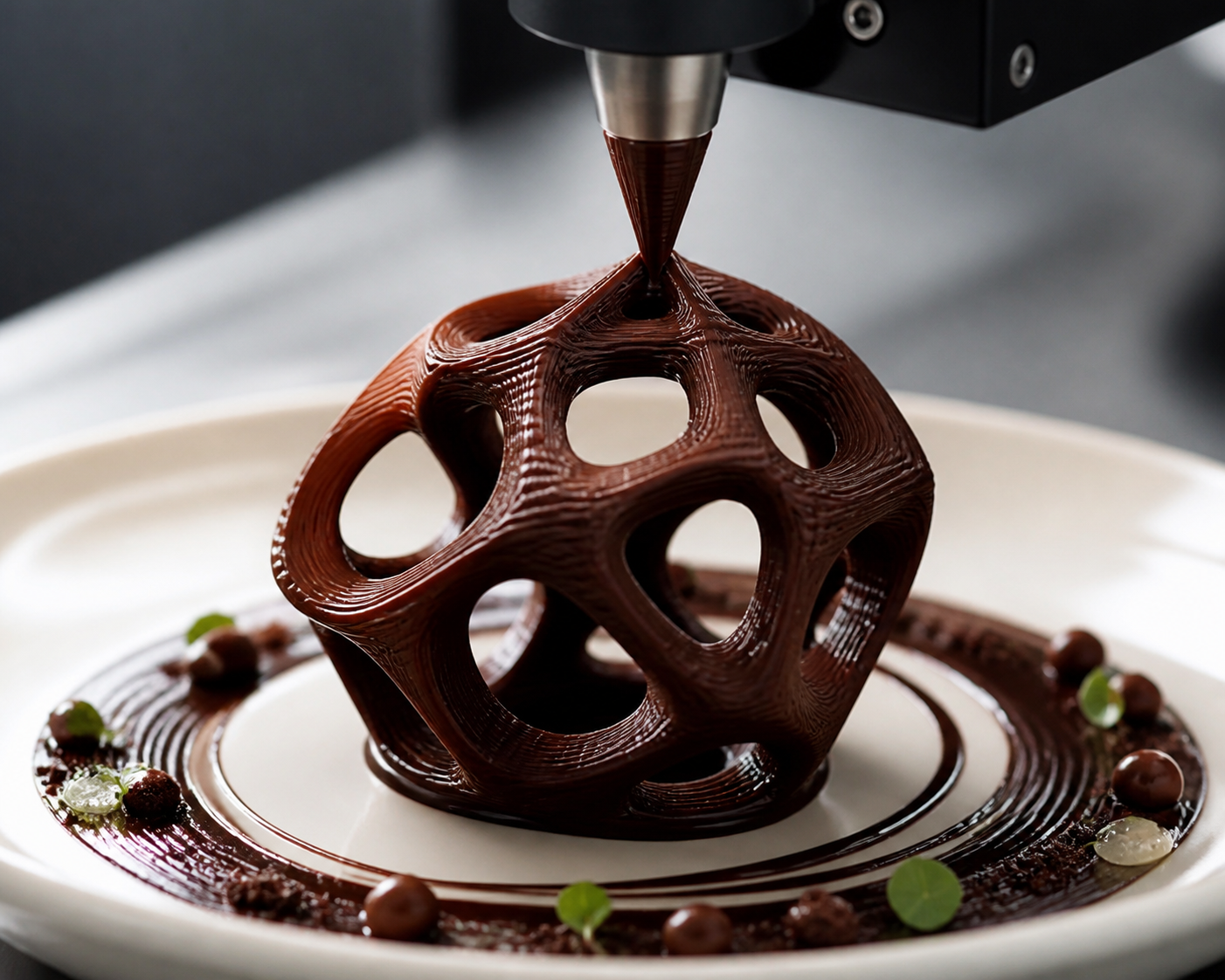
The material system for food 3D printing is expanding rapidly. Chocolate is the most mature material for food 3D printing, possessing excellent extrusion and solidification properties, and can maintain intricate shapes after printing. Chocolate printing requires precise temperature control (typically maintained in a liquid state at 31-34°C), solidifying through cooling after printing is complete. Chocolate 3D printing has been widely applied in high-end dessert customization, wedding cake decoration, and the holiday gift market, representing the most commercialized sector of food 3D printing.
Dough-based materials (bread dough, cookie dough, pizza dough) are another major category of printing materials. The challenges of dough printing lie in controlling the dough's viscoelasticity and fermentation process; after printing, the dough requires baking to become edible. Dough formulations (water content, gluten content, types of leavening agents) need to be optimized for the printing process. Studies indicate that by adjusting dough formulations and printing parameters, it is possible to create internal structures and textures distinct from traditional processes, and even achieve designs with gradient textures (such as crispy on the outside and soft on the inside). The 3D printing of noodles has also been commercialized, enabling the production of three-dimensional noodle shapes that are difficult to achieve using traditional methods.
Plant-based protein is the most promising material direction for 3D food printing. With the growing global demand for sustainable protein, plant-based meats (such as soy protein and pea protein-based meat analogues) have become a hotspot. 3D printing enables precise control over the alignment of plant protein fibers, simulating the fibrous structure and texture of real meat. Israeli company Redefine Meat has launched 3D-printed plant-based steak products, using 3D printing technology to achieve the layered structure of muscle fibers, adipose tissue, and connective tissue, with a texture close to real meat. 3D-printed plant-based seafood (such as imitation shrimp and salmon) is also an emerging direction; through protein recombination and shape printing, products are manufactured with appearance and texture close to real seafood.
Personalized Nutrition and Medical Diet Applications
Personalized nutrition is the most socially valuable application of 3D food printing. 3D printing enables precise control over nutrient composition and the design of spatial distribution, allowing for the customization of nutritional foods for diverse populations (such as the elderly, children, athletes, and patients with chronic diseases). For instance, low-sugar foods can be printed for diabetics, high-protein snacks for athletes, and fun, vitamin-rich foods for children. Through multi-nozzle printing systems, it is also possible to achieve a gradient distribution of different nutrients within a single food item, realizing the concept of "a nutritional solution in every bite."
Diets for patients with dysphagia represent a significant medical application of 3D food printing. Hundreds of millions of people worldwide are affected by dysphagia (including the elderly, stroke patients, and patients with neurological diseases). Traditional liquid foods often have poor texture, suffer from nutrient loss, and lack appetite appeal. 3D printing can produce foods that are safe, easy to swallow, and visually appealing by adjusting the rheological properties (viscosity, elasticity, cohesiveness) of the food. For example, a Japanese research team developed 3D-printed "soft carrots," using a gelation process to allow the carrots to maintain their shape while being easy to chew and swallow. 3D printing can also combine multiple ingredients for printing, improving the texture and nutritional diversity of liquid foods.
Elderly nutritional meals represent another rapidly growing application scenario. The elderly often face issues such as declining chewing ability, reduced appetite, and impaired nutrient absorption. 3D printing can produce meals for the elderly that are soft in texture, visually appealing, and nutritionally balanced, thereby enhancing their dining experience and nutritional status. Through digital nutritional management, personalized recipes can be tailored to each individual's health conditions (such as diabetes, hypertension, and kidney disease). As global population aging accelerates, the market potential for 3D-printed personalized nutritional meals is immense.
Application of Food Printing in Catering and Retail Scenarios
The catering sector provides the ideal stage for 3D food printing to showcase its value. High-end restaurants utilize 3D printing technology to craft exquisite desserts, decorative dishes, and molecular gastronomy, enhancing the dining experience and brand image. Chocolate 3D printers can create customized chocolates directly on-site in restaurants, allowing customers to select shapes, text, and flavors for a "what-you-see-is-what-you-get" personalized experience. Some restaurants also employ 3D printing to produce unique tableware and plating decorations (edible or non-edible), realizing an artistic presentation of dishes.
In retail scenarios, business models for 3D food printing are diversifying. Custom chocolate shops (such as the Japanese company Vow) provide online customization and in-store printing services, allowing customers to upload images or select templates for on-site printing of exclusive chocolates. Bakery chains utilize 3D printing for cake decoration, replacing traditional manual piping to enhance efficiency and consistency. Convenience stores and vending machines are also beginning to pilot the deployment of 3D food printers, offering "print-on-demand" personalized snacks. As equipment costs decrease and material systems mature, 3D food printing is poised to enter a wider range of retail scenarios.
Space and special environment food is a unique application of food 3D printing. NASA has funded food 3D printing research projects to explore the possibility of printing nutritious food during long-term space missions. 3D printed food can reduce the storage space and weight of space food (stored in the form of powdered ingredients and printed on demand), and can be customized according to astronauts' nutritional needs and taste preferences. Similarly, special environments such as military logistics, polar scientific research, and deep-sea operations also benefit from the on-demand manufacturing and personalized customization capabilities of 3D printed food. Although the market size for these special scenarios is limited, they have driven the continuous progress of food 3D printing technology.
Industrialization Challenges: Texture, Safety, and Cost
Despite the promising prospects, the industrialization of 3D food printing still faces multiple challenges. Texture issues are the primary challenge: the structure of many 3D printed foods differs from that of traditional foods, requiring time for consumers to adapt. In particular, the "layered texture" and "textural differences" of printed foods may affect the eating experience. The solution lies in the optimization of material formulations (adding plasticizers and emulsifiers to improve mouthfeel) and the design of printing structures (finer layer heights and optimized internal structures). Furthermore, post-printing processing (such as baking, frying, and steaming) significantly impacts the final texture, necessitating the establishment of synergistic printing-cooking processes.
Food safety is a threshold that must be crossed for industrialization. The hygienic design of 3D printing equipment (food contact materials, detachable parts for cleaning), microbial control of the printing environment, and food safety certification of printing materials (such as FDA and EU food safety standards) are all critical aspects. 3D printing equipment needs to obtain food-grade certification (such as NSF and CE food contact certification), and printing materials must comply with food additive regulations. Furthermore, the establishment of a HACCP (Hazard Analysis and Critical Control Points) system for food 3D printing, product traceability mechanisms, and supporting cold chain logistics are all issues that must be addressed for industrialization.
Cost is the primary factor limiting the large-scale application of 3D food printing. Currently, the cost of 3D food printing equipment is high (industrial-grade equipment costs hundreds of thousands of yuan), printing speeds are slow (printing a single food item takes several minutes to tens of minutes), and material costs are higher than traditional food ingredients (due to the high processing and packaging costs of print-grade ingredients). Reducing costs requires scaled production of equipment, increased printing speeds (multi-nozzle parallel printing), and an optimized material supply chain. Meanwhile, identifying high value-added application scenarios (such as high-end customization, medical diets, and food for special environments) can enable profitability at current cost levels, thereby gradually promoting technological maturity and cost reduction.
Conclusion: 3D Food Printing Opens a New Era of Personalized Food
Food 3D printing is a key direction in the digital transformation of the food industry, with its core value lying in enabling the personalized, nutritional, and artistic manufacturing of food. Although it currently faces challenges such as texture, safety, and cost, with the maturation of technology, enrichment of materials, and reduction in equipment costs, the application scenarios of food 3D printing will continue to expand, transitioning from high-end customization to mass consumption.
In the future, 3D food printing will be deeply integrated with artificial intelligence, big data, and the Internet of Things: AI can automatically generate nutritional recipes based on personal health data and drive the printing process; big data can analyze consumer preferences to optimize product design; and the Internet of Things can enable remote monitoring and intelligent maintenance of printing equipment. 3D food printing may also combine with traditional cooking to form a new "printing + cooking" catering model. For food enterprises and entrepreneurs, grasping the technological trends and business opportunities of 3D food printing will be key to gaining a first-mover advantage in the transformation of the food industry. 3D food printing is not merely a manufacturing technology, but also a completely new food experience and business model, ushering in a new era of personalized food.
Submit a model, drawing, image or written notes. Engineers will review material, process, finishing and delivery based on actual use.