Introduction: 3D Printing Ushers the Construction Industry into the Era of Digital Manufacturing
As one of the largest industrial sectors globally, the construction industry has long relied on traditional casting, masonry, and prefabrication techniques, resulting in low production efficiency, significant material waste, and limited design freedom. The introduction of 3D printing technology is fundamentally transforming this status quo. From early conceptual demonstration models to the current manufacturing of actual architectural components, the application of 3D printing in the construction industry has transitioned from the experimental stage to commercial application. Countries such as the Netherlands, the UAE, China, and the United States have constructed multiple 3D-printed buildings, demonstrating the feasibility and potential of this technology.
The application of 3D printing in the construction industry can be divided into three levels: first, architectural models and design verification, used to showcase design intent and perform design optimization; second, the manufacturing of building components, such as decorative components, irregular formwork, and prefabricated nodes; and third, whole-building printing, which directly "prints" complete building structures using large-scale 3D printing equipment. This article will systematically introduce the innovative applications of 3D printing in various stages of the construction industry, analyze technical advantages, typical cases, and future development trends, providing a comprehensive perspective for practitioners in the construction industry.
Architectural Models and Design Verification: From Handcrafting to Digital Fabrication
Architectural models are indispensable tools in the architectural design process, used to demonstrate design intent, verify spatial relationships, and assist in design decision-making. Traditional architectural model making relies on manual craftsmanship or CNC machining, involving long production cycles (ranging from a few days to several weeks), high costs (ranging from thousands to tens of thousands of yuan), and difficulty in modification. The introduction of 3D printing technology has revolutionized this situation: designers can transform digital models into physical models within hours, at a fraction of the cost of traditional methods, and design modifications only require reprinting, which greatly enhances design iteration efficiency.
The advantages of 3D printed architectural models lie not only in speed and cost, but more importantly in their ability to accurately reproduce complex architectural forms. For parametric designs and free-form architecture (such as the works of Zaha Hadid Architects), traditional model making is almost impossible to achieve, whereas 3D printing can accurately reproduce every curved surface and detail. Full-color 3D printing (such as full-color sandstone printing) can also directly print material textures and color effects, making the models more realistic. Furthermore, 3D printing supports transparent materials (such as UV-curable transparent resin), allowing for the creation of sectional models that reveal internal structures, helping to understand complex architectural spatial relationships.
In architectural proposal presentations and client communication, the value of 3D printed models is particularly prominent. Compared to 2D drawings or digital renderings, physical models provide a more intuitive sense of space, helping non-professionals understand design intent and increasing proposal approval rates. Some leading architectural firms (such as SOM and Gensler) have established 3D printed models as a standard workflow, producing concept and presentation models at multiple scales for every project. With the emergence of large-scale architectural 3D printers (capable of printing models at 1:50 or even 1:20 scale), creating models of large building complexes has become feasible, further expanding the application of 3D printing in the field of architectural modeling.
Manufacturing of Complex Decorative Components and Special-shaped Formwork
Modern architecture increasingly pursues personalized and artistic expression, making complex decorative components and free-form structures design highlights. Traditional manufacturing methods (such as GRC prefabrication, manual carving, and mold casting) for producing complex decorative components involve high costs, long production cycles, and difficulty in guaranteeing quality. 3D printing technology, with its unparalleled design freedom, has become the optimal choice for manufacturing complex decorative components. Whether it is biomorphic facade decoration, parametrically designed perforated screens, or modern interpretations of traditional patterns, 3D printing can precisely realize them.
Concrete formwork is another important application of 3D printing in construction. Manufacturing special-shaped concrete components using traditional wooden or steel formwork requires complex processing and assembly, resulting in high costs and low precision. 3D printed formwork (typically using ABS, PLA, or special engineering plastics) can directly produce formwork of any shape based on digital models, featuring high precision and short production cycles. The printed formwork has a smooth surface, can be reused multiple times, and is lightweight, making it easy to handle and install. For single-use formwork for special-shaped components, the cost-effectiveness of 3D printing is particularly prominent, as there is no need to amortize mold costs.
In terms of practical cases, the Spanish architecture firm IAAC used large-scale FDM printers to fabricate complex concrete formwork for casting free-form concrete benches and sculptures. For the "Office of the Future" building in Dubai, UAE, all complex decorative components of the facade were manufactured via 3D printing, demonstrating the potential of 3D printing in high-end architectural decoration. Multiple cultural tourism projects in China have also adopted 3D printing to produce antique-style components, art installations, and landscape features, preserving traditional aesthetics while reducing costs through modern technology. These cases demonstrate that 3D printing has become an essential tool in architectural decoration and the fabrication of free-form components.
Prefabricated Component Manufacturing and Joint Connection Technology
Prefabricated buildings represent a key direction in the industrialization of the construction industry, and 3D printing technology can significantly enhance the manufacturing efficiency and performance of prefabricated components. Traditional prefabricated components typically adopt standardized designs to meet the economic requirements of mold manufacturing. 3D printing breaks this limitation, enabling the production of highly customized prefabricated components without mold costs. For small-batch, non-standard prefabricated components (such as specially shaped balconies, irregular beam-column joints, and integrated equipment pipeline modules), 3D printing offers significant cost advantages.
Material selection for 3D printed prefabricated components is diverse: concrete-based materials (such as fiber-reinforced concrete and geopolymer concrete) are suitable for structural components; polymer-based materials (such as fiber-reinforced plastics and UHPC) are suitable for decorative and functional components; metal materials (such as stainless steel and weathering steel) are suitable for high-precision connectors and reinforcements. In particular, fiber-reinforced concrete 3D printing, by incorporating steel fibers, glass fibers, or carbon fibers into the concrete, can significantly enhance the tensile strength and toughness of the components, achieving performance levels previously attainable only with traditional reinforced concrete.
Node connection is a key technology in prefabricated buildings. The connection of traditional prefabricated components mostly employs welding of embedded parts or bolted connections, which involves a large amount of on-site work and high precision requirements. 3D printing can manufacture complex node connectors to achieve rapid and precise connections. For example, printing node connectors with precision positioning pins and slots can significantly simplify on-site assembly work. Some innovative projects also attempt to integrate functions such as pipelines, thermal insulation, and waterproofing into prefabricated components, achieving multi-functional integrated manufacturing through 3D printing, thereby reducing on-site operation processes and improving building quality and construction efficiency.
Large-scale Construction 3D Printing: From Concept to Reality
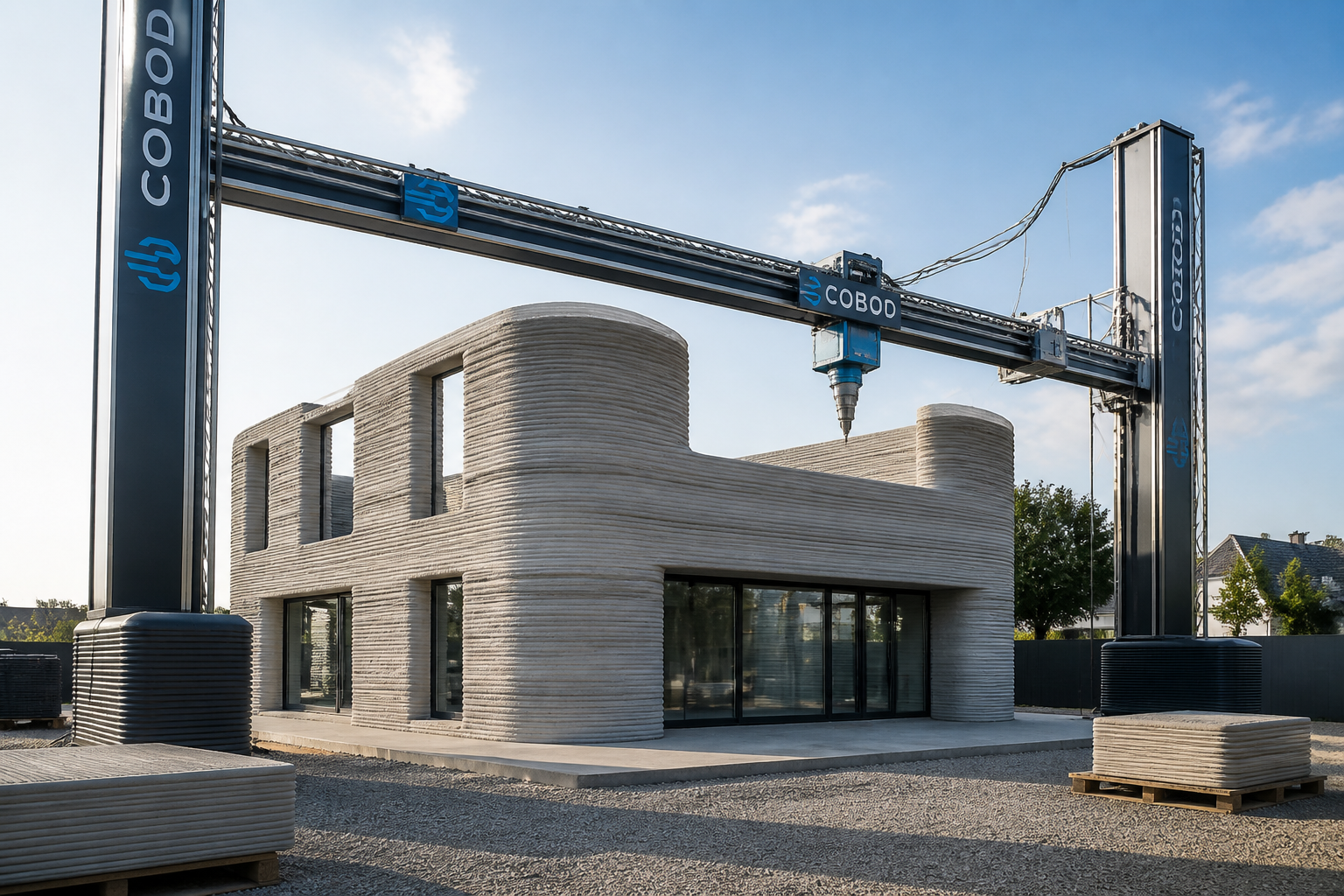
Large-scale architectural 3D printing is the most compelling application area. Using specially designed large-scale 3D printers (typically employing gantry or robotic arm structures), entire buildings or main building structures can be directly "printed." The printing materials are typically specially formulated concrete-based materials, which are extruded through a nozzle and deposited layer by layer to form the structure. Compared to traditional construction methods, 3D printed buildings offer significant advantages, including rapid construction speed (a 200-square-meter single-story residence can be completed within 24 hours), minimal material waste (material utilization rate approaching 100%), and low labor requirements (requiring only 2-3 operators).
In terms of technical challenges, large-scale construction 3D printing faces multiple challenges involving materials, equipment, structure, and standards. Regarding materials, special concrete suitable for extrusion and rapid setting needs to be developed to ensure both extrusion flowability and interlayer bond strength, as well as early-age strength. In terms of equipment, the positioning accuracy, motion stability, and reliability of large-scale printers require continuous optimization. Regarding structure, the seismic performance, durability, and joint connections of 3D printed buildings require systematic research. In terms of standards, the current lack of design and construction standards for 3D printed buildings limits their large-scale application.
Despite numerous challenges, 3D printed construction has achieved remarkable results. Yingchuang Building Technology in China has printed multiple villas and multi-story buildings in Suzhou, Shanghai, and other locations, demonstrating the maturity of the technology. Eindhoven University of Technology in the Netherlands collaborated with construction companies to print the world's first 3D printed concrete bridge, which has been put into use. The government of Dubai, UAE, announced that 25% of new buildings will adopt 3D printing technology by 2030, and has already piloted applications in government buildings. These projects demonstrate that 3D printed construction has moved from proof of concept to engineering practice, and is expected to become an important branch of the construction industry in the future.
Sustainable Architecture and Green Manufacturing
Sustainability is an important value proposition of 3D printing in the construction industry. Traditional construction generates a large amount of construction waste (accounting for approximately 30%-40% of municipal solid waste), whereas 3D printed buildings produce almost no construction waste through precise material placement. Furthermore, 3D printing can optimize structural designs to reduce material usage. For example, by using topology optimization to design hollow walls or lattice-structured walls, concrete usage can be reduced by 30%-50% while ensuring structural integrity, significantly lowering the building's carbon emissions.
3D printing also supports the use of environmentally friendly building materials. Construction waste (such as crushed concrete and brick fragments) can be used as aggregates for 3D printed concrete after crushing and screening, achieving the resource utilization of construction waste. Industrial waste (such as fly ash, slag, and tailings) can also be used as cementitious materials or admixtures to reduce cement consumption (cement production accounts for 8% of global CO2 emissions). Some innovative projects have even attempted to use local soil (with added binders) as printing materials, achieving green construction with "local sourcing and zero transportation."
Energy consumption during the operational phase of buildings can also be optimized through 3D printing. 3D printing can fabricate complex double-layer skins and ventilation systems, improving the thermal insulation and ventilation performance of buildings, thereby reducing energy consumption for air conditioning and lighting. Printed free-form shading components can be optimized based on solar angles to achieve passive energy savings. Furthermore, the structural optimization design of 3D printed buildings (such as reducing material usage and optimizing load paths) also indirectly reduces the embodied carbon emissions of buildings. With the global emphasis on carbon neutrality, the value of 3D printing in green buildings and sustainable construction will become increasingly prominent.
Cost-Benefit Analysis and Commercialization Path
The economic analysis of 3D printed buildings requires a comprehensive consideration of equipment investment, material costs, construction costs, design costs, and lifecycle costs. Currently, the equipment investment for 3D printed buildings is relatively high (prices for large-scale printers range from hundreds of thousands to several million RMB), and material costs are also higher than those of traditional concrete (the price of specialized printing materials is approximately 2-3 times that of ordinary concrete). However, in specific application scenarios, the comprehensive cost of 3D printing is already lower than that of traditional methods.
Applicable scenarios include: first, complex freeform architecture, where traditional methods require extensive formwork and manual labor, resulting in high costs; second, remote areas or post-disaster reconstruction, where transporting traditional building materials is difficult, while 3D printing can utilize local materials or use prefabricated material kits; third, small-batch customized buildings (such as boutique homestays and landscape structures), where traditional methods struggle to achieve economic viability; and fourth, emergency temporary structures (such as field hospitals and emergency housing), where the rapid deployment advantage of 3D printing is significant. In these scenarios, 3D printed buildings have already achieved commercial viability.
In terms of commercialization paths, there are currently three main models: the first is the equipment sales model, which involves selling 3D printing equipment to construction companies or enterprises and providing technical support; the second is the printing service model, which offers 3D printing construction services charged by area or by project; and the third is the comprehensive solution model, providing a one-stop service ranging from design, materials, and printing to post-construction decoration. Different models are suitable for different enterprises: the equipment sales model is suitable for equipment manufacturers; the printing service model is suitable for construction technology companies; and the comprehensive solution model is suitable for large construction groups. As technology matures and costs decrease, the application scenarios for 3D printed buildings will further expand, and business models will become increasingly diversified.
Conclusion: 3D Printing Reshapes the Future of the Construction Industry
The application of 3D printing technology in the construction industry has evolved from concept to practice, and from model making to actual construction. Its advantages in design freedom, construction efficiency, material savings, and sustainability make it a significant driving force for the digital transformation of the construction industry. Although it currently faces challenges regarding technology, regulations, and costs, these obstacles will be gradually overcome with technological advancements and large-scale application.
In the future, 3D printed construction will develop towards intelligence, automation, and integration. Deep integration with BIM (Building Information Modeling) will enable a seamless transition from design to printing; integration with robotic systems will automate auxiliary processes such as rebar placement and pipeline installation; and integration with AI technology will enable print path optimization, structural performance prediction, and construction quality monitoring. For professionals in the construction industry, understanding and mastering 3D printing technology will be a key component of future competitiveness. 3D printing is not merely a new construction tool but also a catalyst for innovative thinking and business model transformation in the construction industry.
Submit a model, drawing, image or written notes. Engineers will review material, process, finishing and delivery based on actual use.