Market Demand Characteristics of Small Batch Production
The importance of small batch production (typically referring to production runs of 10-1000 pieces) is becoming increasingly prominent in modern manufacturing. As market demands become more diversified and personalized, and product lifecycles continue to shorten, enterprises require more flexible and rapid production methods to respond to market changes. Although traditional mass production methods (such as injection molding and stamping) offer low unit costs, they require high investments in tooling and fixtures (mold costs can reach tens of thousands to hundreds of thousands of yuan) and have long production preparation lead times (typically 4-12 weeks), making them unsuitable for small batch production.
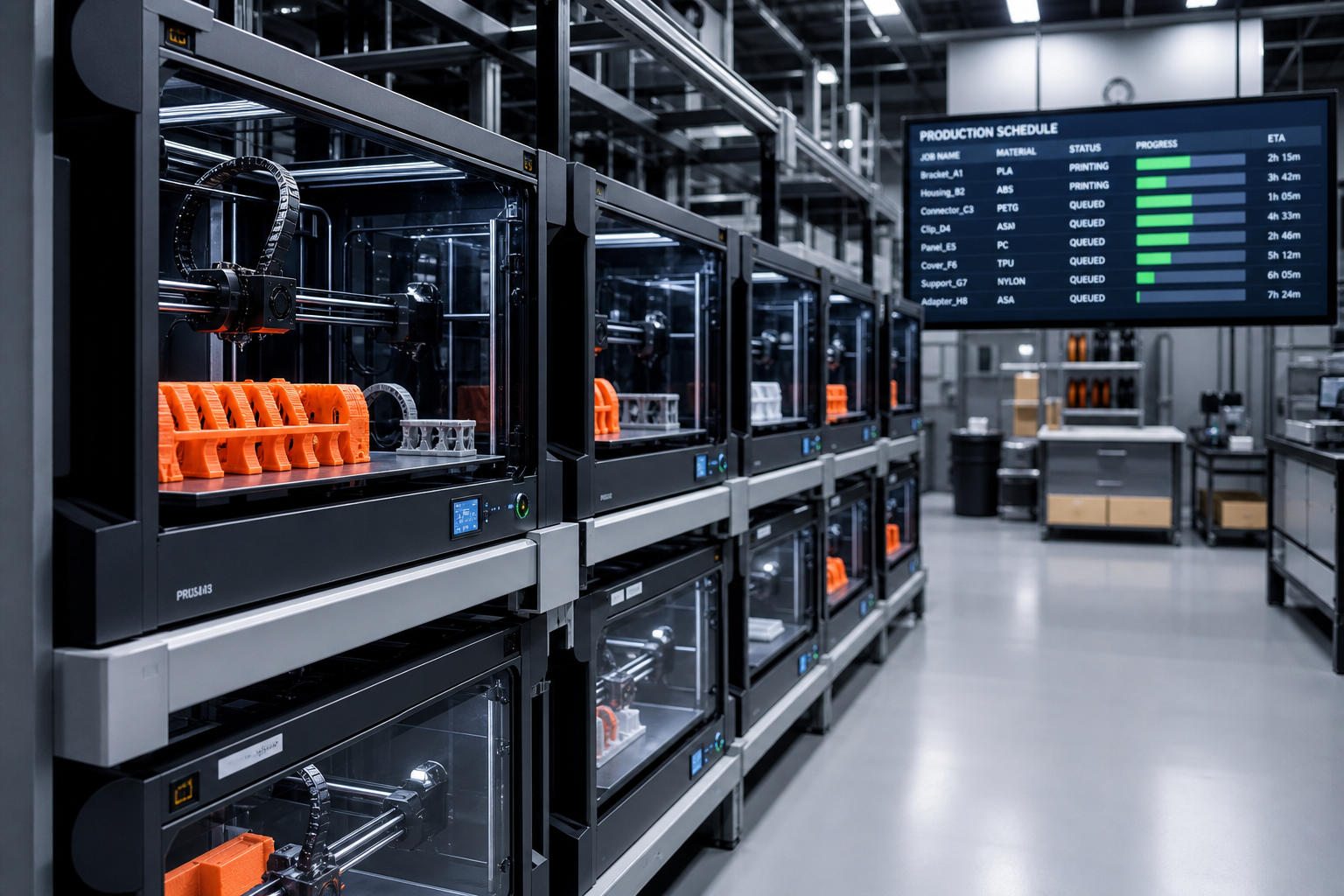
With its characteristics of "mold-free, rapid response, and high flexibility," 3D printing technology has become an ideal choice for low-volume production. Requiring no tooling or fixtures, 3D printing can convert digital models into physical parts within 24 hours, with unit costs remaining constant (or changing minimally) regardless of batch size. This gives 3D printing significant cost and time advantages in low-volume production. Understanding the demand characteristics of low-volume production is the foundation for formulating a manufacturing strategy.
Cost Model and Break-even Point Analysis
Comparing the costs of 3D printing and traditional manufacturing requires establishing a complete cost model. For traditional manufacturing (taking injection molding as an example), total cost = mold cost + unit material cost × quantity + unit processing cost × quantity + other costs (such as transportation and management). For 3D printing, total cost = unit printing cost × quantity + post-processing cost × quantity + other costs. Since 3D printing involves no mold costs, the total cost of 3D printing is lower when production volume is small; when production volume exceeds a certain "break-even point," the total cost of traditional manufacturing is lower.
Example calculation of the break-even point: Assume the injection mold cost is 50,000 RMB, the unit injection molding cost is 10 RMB, and the unit 3D printing cost is 150 RMB. Break-even point = 50,000 / (150 - 10) = 357 units. That is, when the production quantity is less than 357 units, 3D printing is more economical; when the production quantity is greater than 357 units, injection molding is more economical. It is important to note that this calculation does not account for hidden costs such as time costs, design change costs, and inventory costs. If these factors are taken into account, the break-even point for 3D printing would be higher, potentially reaching 500-1,000 units.
Cost Comparison of Different Processes
The results of cost comparisons between different 3D printing processes and traditional manufacturing vary. For the FDM process, due to lower equipment and material costs, the break-even point is typically low (50-200 parts); for SLA/DLP processes, equipment and material costs are moderate, with a break-even point between 100 and 300 parts; for the SLS process, equipment costs are higher but material utilization is high, resulting in a break-even point of 200-500 parts; for SLM metal printing, both equipment and material costs are high, with a break-even point of 50-150 parts (compared to CNC machining).
Compared to traditional CNC machining, the cost advantage of 3D printing is more pronounced for small batches of complex parts. The costs of CNC machining include: programming time (2-8 hours), setup time (0.5-2 hours), machining time (proportional to part complexity), tooling costs, material costs, etc. For simple parts, the unit cost of CNC machining may be lower than that of 3D printing; however, for complex parts (such as those with features like internal cavities, flow channels, and thin walls), CNC machining time can extend to tens of hours, with unit costs reaching thousands of yuan, whereas 3D printing may only require several hours, with unit costs of just a few hundred yuan. Therefore, part complexity is a significant factor influencing the break-even point.
Time Cost and Rapid Response Advantages
In cost analysis, time costs are often overlooked, but in reality, they may be more important than direct costs. For new product development, a delay of just one week in time-to-market can result in millions in lost revenue. The rapid response capability of 3D printing (typically a 1-3 day turnaround) can significantly shorten product development cycles and accelerate time-to-market. Traditional manufacturing, requiring tooling design and production, typically involves a lead time of 4-12 weeks, which can be unacceptable for rapidly changing markets.
Furthermore, the "on-demand production" model of 3D printing can eliminate inventory costs. Traditional manufacturing typically requires mass production to reduce unit costs, resulting in significant inventory backlogs that tie up capital and warehouse space. 3D printing enables production only when needed, facilitating "zero inventory" or "low inventory" operations. The advantages of this model are particularly pronounced for products with short lifecycles and uncertain demand. For instance, a consumer electronics company utilized 3D printing for the on-demand production of mobile phone accessories, reducing inventory costs by 80% and the stockout rate by 90%, significantly improving customer satisfaction.
Design Flexibility and Customization Capabilities
The design freedom of 3D printing is unparalleled by traditional manufacturing. Constrained by process limitations, traditional manufacturing makes many design features (such as complex internal cavities, conformal cooling channels, and integrated structures) impossible to achieve or prohibitively expensive. 3D printing can realize almost any geometric shape, enabling designers to focus on functional optimization without compromising due to manufacturing constraints. This "design-driven manufacturing" paradigm can significantly enhance product performance and create higher market value.
Customized production is another unique advantage of 3D printing. In traditional manufacturing, achieving customization requires creating specialized molds for each variant, incurring extremely high costs. 3D printing requires only modifying the digital model without the need for additional tooling, enabling "mass customization"—the production of personalized, customized products at the cost and speed of mass production. For example, hearing aid shells have achieved fully personalized customization through 3D printing; each shell is customized based on scan data of the user's ear canal shape, significantly improving comfort and sound quality, while costs are only 10%-20% higher than standardized production.
Quality Consistency and Process Stability
For small-batch production, quality consistency is a crucial consideration. Traditional manufacturing (particularly injection molding) offers high quality stability during mass production; however, in small-batch production, the initial scrap rate may be relatively high due to the time required for equipment setup and process optimization. The quality stability of 3D printing is influenced by equipment status and process parameters, yet parts printed on the same machine using identical parameters typically exhibit good quality consistency (dimensional deviation of ±0.1-0.3mm).
Measures to improve 3D printing quality consistency include: 1) Regular equipment calibration—ensuring the stability of parameters such as axis motion accuracy, temperature control accuracy, and laser power; 2) Standardization of process parameters—establishing a standard process parameter library to avoid arbitrary parameter changes; 3) Environmental control—maintaining stable temperature and humidity in the printing environment to prevent environmental factors from affecting print quality; 4) Operator training—ensuring that operators understand process principles and can correctly handle abnormal situations. Through these measures, the quality consistency of 3D printing can reach or even exceed the level of traditional manufacturing.
Decision Framework and Implementation Recommendations
When selecting a manufacturing strategy, enterprises can refer to the following decision-making framework: 1) Evaluate production volume—if the batch size is below the break-even point (typically 100-500 parts), prioritize 3D printing; 2) Evaluate part complexity—if the part has complex geometric features (internal cavities, flow channels, thin walls, lattices), 3D printing offers greater advantages; 3) Evaluate time requirements—if rapid delivery is required (
Submit a model, drawing, image or written notes. Engineers will review material, process, finishing and delivery based on actual use.