Introduction: Current situation of 3D printing talent shortage
According to the "China 3D Printing Industry Development Report 2025", the talent gap in the domestic 3D printing industry has exceeded 120,000, of which application engineers, material R&D personnel and equipment operation and maintenance engineers are most in short supply. After an automobile manufacturing company introduced 3D printing technology, due to a lack of professional operating personnel, the equipment utilization rate was only 35%, which seriously restricted the implementation of the technology. The shortage of talents not only affects the technological transformation process of enterprises, but also restricts the sustainable development of the entire industry. Building a scientific and systematic 3D printing talent training system has become a strategic issue that enterprises urgently need to solve.
1. Skill identification and capability model
The first task in building a training system is to clarify the core competencies that talents should possess. Through research on more than 50 application companies, we divided the 3D printing talent skill system into three major dimensions and six levels.
1. Skill classification system
Technical skills dimension: Including core capabilities such as 3D modeling and design (CAD/CAE software application), printing process selection and optimization, material performance and application, equipment operation and maintenance, and post-processing technology. This is the basic skill of 3D printing engineers, which determines the depth of technology application.
Engineering application dimension: Covers capabilities such as product structure design optimization, process planning, quality control and testing, cost analysis and project management. This requires talents to have the ability to integrate interdisciplinary knowledge and be able to effectively integrate 3D printing technology into actual production scenarios.
Innovation capability dimension: Including cutting-edge capabilities such as new material application exploration, process innovation research and development, and intelligent production solution design. This is the core competitiveness of senior talents and determines the company's technological leadership.
2. Five-level competency model
| Level | Competency requirements | Typical positions | Training cycle |
|---|---|---|---|
| L1-Junior Operator | Master the basic operation of equipment and simple model printing | Printing Operator | 1-2 months |
| L2-Intermediate Technician | Independently complete complex printing and basic maintenance | Technician, Assistant Engineer | 3-6 months |
| L3-Application Engineer | Process design, parameter optimization, problem diagnosis | Application Engineer | 6-12 months |
| L4-Senior Engineer | Process R&D, Material Application, Team Guidance | Senior Engineer, Project Manager | 1-2 years |
| L5-Technical Expert | Technical strategic planning, innovative research and development, industry standard formulation | Technical Director, Chief Engineer | More than 3 years |
After an aerospace company adopted this model, the efficiency of talent echelon construction increased by 40%, and the internal promotion rate reached 65%, effectively solving the dilemma of relying on external recruitment for senior talents.
2. Training course system design
Based on the competency model, we have designed a four-level 3D printing training course system, covering theoretical knowledge and practical skills, forming a systematic talent training path.
1. Course structure design
Basic course modules (40 credit hours): Introduction to 3D printing technology (8 credit hours), mainstream process principles (12 credit hours), basic knowledge of materials (10 credit hours), and industry application cases (10 credit hours). This module is aimed at new employees and engineers in technology transition to establish a complete knowledge framework.
Professional course modules (80 hours):Special training on 3D modeling (20 hours), printing process and parameter optimization (24 hours), equipment operation training (20 hours), post-processing technology (16 hours). Each course module includes three links: theoretical explanation, case analysis and practical exercises.
Advanced course modules (60 credit hours):Material R&D and application (16 credit hours), process innovation design (16 credit hours), quality control system (12 credit hours), cost optimization analysis (8 credit hours), project management practice (8 credit hours). This module is aimed at L3-L4 level talents and cultivates systematic engineering thinking.
Advanced training module (40 hours): Cutting-edge technology trends (8 hours), intelligent production solutions (12 hours), technology strategic planning (12 hours), industry research and practice (8 hours). For L5 level technical experts, expand strategic horizons.
2. Key points of training content
The course design follows the four-link teaching method of "theory-case-practice-assessment". Taking the Printing Process Optimization Course as an example, the theoretical part explains the characteristics of mainstream processes such as FDM, SLA, and SLM; the case analysis part provides an in-depth analysis of the process optimization process of a medical device company, including parameter adjustment, defect diagnosis, quality improvement and other practical operations; the practical part requires students to independently complete a process optimization task and provide real production data support; the assessment part uses a project defense format to evaluate the students' comprehensive application capabilities.
After an electronics manufacturing company introduced this course system, the training cycle was shortened from an average of 8 months to 5 months, the training pass rate increased from 62% to 89%, and the talent adaptation period was reduced by 50%.
3. Practical training and skill improvement
Theoretical knowledge needs to be transformed into practical abilities through systematic practical training. We have built a three-in-one practical training system of "training base-project practice-teacher guidance".
1. Construction of training base
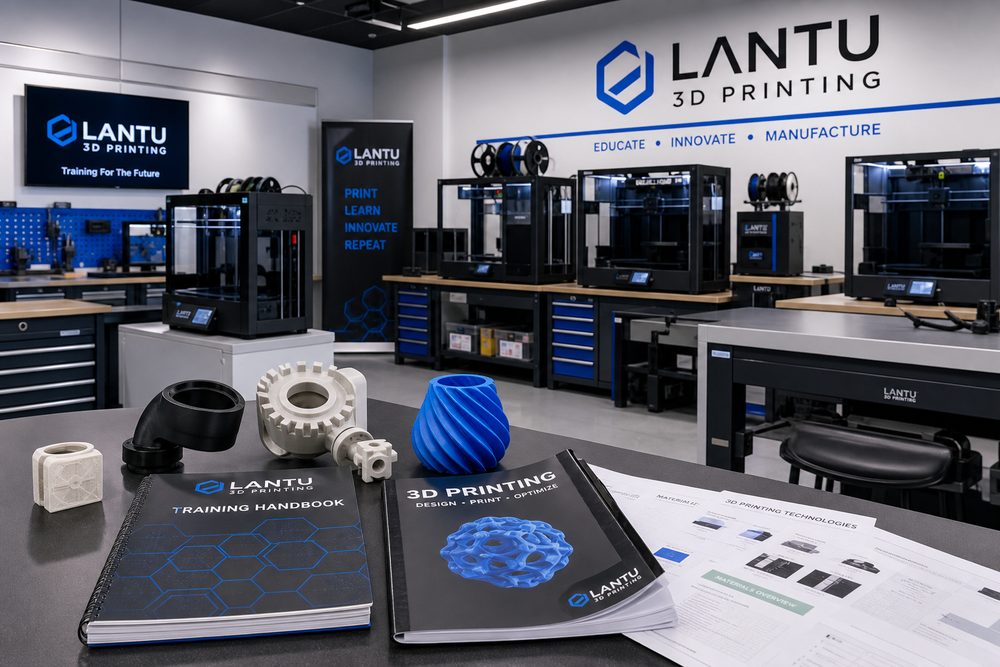
Enterprises should establish a well-equipped 3D printing training center equipped with mainstream equipment such as FDM, SLA, and SLM, as well as supporting equipment such as 3D scanners and post-processing workstations. The training center is functionally divided according to the "teaching area-practice area-testing area" to meet different levels of training needs.
An auto parts company invested 2 million yuan to build a training center, equipped with 10 industrial-grade printing equipment and complete teaching facilities, with an annual training capacity of 200 people. The training center not only serves internal talent training, but also serves as an industry-university-research base for cooperation with universities, forming an important channel for talent introduction.
2. Project practice mechanism
Real projects are the best training carrier. Enterprises should establish a "training-practice-feedback" closed-loop mechanism to allow students to participate in actual production projects under the guidance of instructors. Practical projects are divided into three levels according to difficulty:
- Basic projects: Simple fixture printing, sample production, etc., to cultivate basic operational abilities;
- Advanced projects:Functional parts design and printing, process optimization, etc., to cultivate engineering application capabilities;
- Challenge projects: New material applications, process innovation, printing of complex structural parts, etc., to cultivate innovative research and development capabilities.
After an aerospace company implemented a project practice mechanism, trainees’ ability to complete projects independently improved significantly: the basic project completion rate increased from 78% to 96%, the advanced project completion rate increased from 45% to 72%, and the challenge project participation rate increased from 15% to 38%.
3. Tutor teaching system
Establish a "one-on-one" tutoring mechanism, with senior engineers above the L4 level serving as tutors and responsible for practical guidance and technical Q&A of students. Instructor responsibilities include: formulating personalized training plans, regular technical guidance, project process supervision, and skills assessment feedback. Enterprises should establish a mentor incentive mechanism, incorporate talent training into performance appraisals, and link mentor training results with promotions and rewards.
Two years after a mold manufacturing company implemented a mentoring system, it has trained 15 L3 engineers and 5 L4 engineers. The internal talent supply rate has reached 80%. Each mentor has received a performance reward of 20,000 yuan, forming a virtuous cycle of talent training.
4. Team building and talent motivation
Talent training is not an isolated individual behavior. It requires the support of an organizational structure and the guarantee of an incentive mechanism to form a sustainable development talent echelon.
1. Organizational structure design
Enterprises should establish a four-level talent echelon of "technical director-project manager-engineer-technician" to form a clear development path. The technical director is responsible for technical strategic planning and team building; the project manager is responsible for the organization and implementation of specific projects; the engineer is responsible for technical solution design and process optimization; and the technician is responsible for daily operations and basic maintenance.
A medical device company established a 3D printing technology team based on this structure. The team size grew from the initial 5 people to 25 people, supporting the company's additive manufacturing business with an annual output value of 50 million yuan. The key to team building is to clarify the boundaries of responsibilities and development paths at each level so that talents can see clear room for growth.
2. Construction of incentive mechanism
Salary incentives: Establish a salary system linked to ability levels. The salary gap for L1-L5 engineers is maintained at 30%-50% to encourage talents to continue to improve. After a company implemented a skill-level salary system, employees' willingness to actively learn increased by 85%, and the participation rate in skill-level examinations reached 92%.
Development incentives: Establish a dual-track system of technical promotion channel and management promotion channel. Technical talents can be promoted to senior positions such as chief engineer and technical director, and enjoy the same remuneration and development opportunities as managers. This avoids the career dilemma of technical talents being "forced to switch to management".
Honorary incentives: Establish honorary awards such as "Technological Innovation Award", "Excellent Mentor Award" and "Skills Pacesetter" to regularly commend outstanding talents. A company invests 100,000 yuan in incentive funds every year to hold technological innovation competitions. The employee participation rate reaches 75%, and a total of 23 innovative results have been produced, with direct economic benefits of 3 million yuan.
3. Knowledge sharing mechanism
Establish an internal knowledge base and technology sharing platform to encourage engineers to share technical insights and case experience. Regularly hold technical salons and experience exchange meetings to promote the flow of knowledge and improve capabilities within the team. A certain enterprise established a "technical knowledge points system" to link knowledge contribution with performance. Within two years, it accumulated more than 800 technical documents, forming valuable technical assets.
Summary
The construction of a 3D printing talent training system is a systematic project that needs to be promoted collaboratively from four dimensions: skill identification, course design, practical training, and team building. The core key points include: establishing a clear competency model and skill classification system; designing training courses with clear levels and solid content; building a practical training mechanism that integrates practical training bases, project practice, and mentorship; establishing an organizational structure and incentive mechanism to ensure the sustainable development of the talent echelon.
Enterprises should formulate phased talent training plans based on their own development stages and technical needs. In the short term, we can focus on the training of basic operating personnel to solve the urgent need for employment; in the medium term, we should cultivate application engineers and process research and development talents to enhance the depth of technology application; in the long term, we should reserve technical experts and innovative talents to support the development of technological strategies. Through continuous investment and system construction, enterprises will surely build a strong talent team to support the application and development of 3D printing technology.
Submit a model, drawing, image or written notes. Engineers will review material, process, finishing and delivery based on actual use.