Introduction: Design Challenges and Opportunities of Dissimilar Material Combinations
Modern product design is increasingly inclined to use multiple material combinations to give full play to the performance advantages of different materials. For example, the combination of rigid structural parts and flexible seals, the combination of metal skeleton and plastic shell, the combination of conductive materials and insulating materials, etc. 3D printing technology provides an unprecedented degree of freedom for realizing the bonding design of dissimilar materials. It can achieve complex material combinations that are difficult to achieve with traditional manufacturing through multi-material printing or post-printing assembly. However, the differences in physical and chemical properties between dissimilar materials (such as thermal expansion coefficient, elastic modulus, surface energy) bring unique challenges to bonding design.
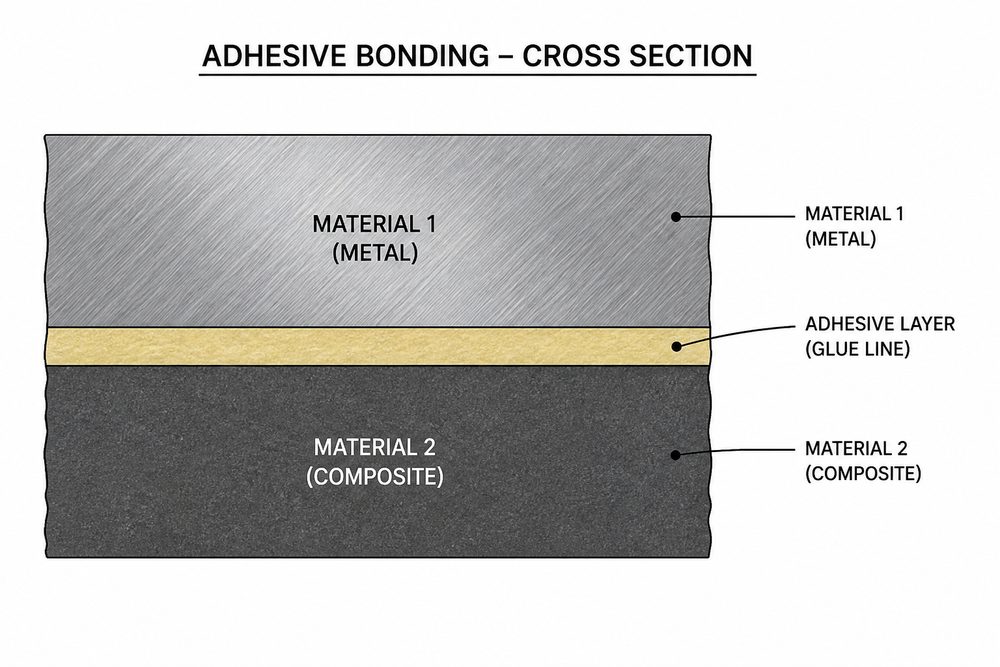
Adhesive failure is one of the most common failure modes of dissimilar material combinations. Due to the mismatch in thermal expansion coefficients of materials, temperature changes may cause shear stress at the bonding interface; due to differences in elastic modulus, stress concentration occurs at the interface during load transfer; due to differences in surface energy, the adhesive has different wettability of the two materials, affecting the bonding strength. Therefore, the bonding design of dissimilar materials requires systematic consideration of multiple dimensions such as material selection, adhesive selection, interface design, and process control to ensure the reliability of the connection. This article will delve into the core points of 3D printing dissimilar material bonding design and provide engineers with practical design guidelines.
Material compatibility evaluation and selection principles
The primary issue when combining dissimilar materials is material compatibility. Compatibility assessment should be conducted from three dimensions: physical compatibility, chemical compatibility and process compatibility. Physical compatibility focuses on coefficient of thermal expansion (CTE) matching. Material combinations with too large CTE differences (such as aluminum CTE=23×10⁻⁶/K and PC plastic CTE=65×10⁻⁶/K) will produce huge thermal stress when the temperature changes, leading to bonding failure or part deformation. The design principle is to choose materials with similar CTE as much as possible, or to compensate for CTE differences through structural design (such as flexible transition zones).
Chemical compatibility evaluates whether chemical reactions between materials occur. Certain plastics (such as ABS, PC) and specific adhesives (such as glues containing ketone solvents) may swell or stress crack; metals and acidic adhesives may corrode. Material compatibility tests should be conducted before design, including immersion tests, stress cracking tests, etc. Process compatibility focuses on whether two materials can be manufactured and joined using the same or compatible processes. For example, PLA and ABS can be printed by FDM, but the printing temperatures are different, and segmented printing or post-assembly solutions need to be designed.
Functional compatibility is another key consideration in material selection. Dissimilar material combinations are usually intended to achieve functional complementarity, so material properties should match functional requirements. For example, conductive materials (such as copper, conductive resin) are selected for parts that need to be conductive, engineering plastics are selected for parts that need to be insulated; high-hardness materials (such as tool steel, ceramics) are selected for wear-resistant surfaces, and elastomers (such as TPU) are selected for parts that need to be cushioned. Material selection should also consider cost, availability and environmental impact,On the premise of satisfying functions, priority should be given to mature, economical and environmentally friendly material combinations.
Adhesive selection: from epoxy resin to structural adhesive
Adhesives are the core media for connecting dissimilar materials. Choosing a suitable adhesive requires comprehensive consideration of factors such as the type of material to be adhered, the type of stress, the working environment, process requirements and cost. Epoxy is the most versatile structural adhesive. It has the advantages of high strength, chemical corrosion resistance, and low shrinkage. It is suitable for various material combinations such as metal-metal, metal-plastic, ceramic-plastic, etc. Two-component epoxy resin can achieve different curing times and performance characteristics by adjusting the formula, and is the mainstream choice for industrial applications.
Acrylic structural adhesive (such as methacrylate) cures quickly (initial solidification within a few minutes), has good adhesion to a variety of materials (including difficult-to-adhesion plastics such as PE and PP), and is suitable for rapid assembly applications. Polyurethane glue (PU) has excellent flexibility and impact resistance, and is suitable for bonding elastic materials and rigid materials, or connections that need to withstand dynamic loads. Silicone glue has good high temperature resistance and weather resistance, and is suitable for outdoor or high-temperature environment applications. However, its strength is low and it is usually only used for sealing rather than structural connection. Cyanoacrylate (instant cyanoacrylate, 502) cures very quickly and is suitable for temporary fixing of small areas. However, it is highly brittle and has poor moisture resistance, making it unsuitable for structural applications.
Adhesive selection also needs to consider processability. Two-component adhesives require precise proportioning and mixing, and take longer to operate; one-component adhesives (such as moisture-curing polyurethane) are more convenient to use, but require specific curing conditions. For mass production, the adhesive application method (hand coating, dispensing machine, spraying) and curing method (room temperature curing, thermal curing, UV curing) should be considered. UV curing glue cures very quickly (a few seconds to tens of seconds) and is suitable for automated production, but it requires at least one of the adhered materials to be transparent. When selecting an adhesive, it is recommended to refer to the technical data sheet provided by the supplier and conduct actual bond strength testing to verify it.
Adhesive surface design: geometry and surface treatment
The geometric design of the adhesive surface directly affects the bonding strength. The basic principle is to maximize the effective bonding area and avoid stress concentration. For connections subject to tensile or shear loads, surface bonding should be used rather than point or line bonding. For thin plate materials, lap joints can be used to increase the load-bearing capacity by increasing the lap length. However, excessive overlap length may cause stress concentration at the end of the joint. It is usually recommended that the overlap length be 10-20 times the thickness of the bonding surface. For connections that are subject to peeling loads, stiffener designs should be used or mechanical connection assistance should be used instead.
Surface treatment is a key step to improve bonding strength. There are usually release agent residues, oil stains or low surface energy layers on the surface of 3D printed parts, which seriously affect the bonding effect. Mechanical treatment (such as grinding, sandblasting) can increase surface roughness and specific surface area, and improve mechanical embedding effect. Chemical treatments (such as plasma treatment, flame treatment, pickling) can change the surfaceThe chemical composition of the surface increases the surface energy and improves the wettability of the adhesive. For difficult-to-bond plastics (such as PE, PP, PTFE), special surface treatment technology (such as Corona discharge, laser treatment) is required to effectively bond. Bonding should be carried out as soon as possible after surface treatment to avoid re-contamination of the surface.
The design of the geometric features of the bonding surface should also consider adhesive flow and exhaust. Design diversion grooves or glue overflow grooves to guide the flow of adhesive and avoid bubble retention. For large-area bonding, a dot matrix glue pattern (such as grid, spiral) can be used to ensure bonding strength and facilitate exhaust. The control of the bonding gap is also very important. If the gap is too large, the amount of adhesive will increase and the curing shrinkage will be large; if the gap is too small, the adhesive will be difficult to completely fill. It is usually recommended to control the bonding gap within the range of 0.1-0.5mm, and use spacers or positioning pins to ensure uniform gaps.
3D printing unique bonding design strategy
3D printing technology provides unique possibilities for bonding design of dissimilar materials. Multi-material 3D printing (such as Stratasys PolyJet, 3D Systems MultiJet) can manufacture parts with multiple material combinations in a single printing. It can achieve a gradual transition between materials instead of a sudden interface, which fundamentally eliminates the problem of interface stress concentration. Although the cost of multi-material printing equipment is relatively high, for complex functional parts (such as soft-hard robot grippers and sensor integrated structures), the design freedom is far greater than that of traditional manufacturing.
For single-material 3D printing, the connection of dissimilar materials can be achieved by designing the embedded part structure. Pause during the printing process to embed a piece of metal or other material, then continue printing to wrap the piece, creating a mechanical interlocking structure. This method is suitable for embedding small parts such as nuts, wires, sensors, etc. The design key points are that there should be grooves or holes on the surface of the embedded parts to facilitate the flow of printing materials to form mechanical locks; the embedded parts must be positioned accurately to avoid print head collisions; the printing parameters (such as temperature and speed) need to be adjusted to avoid overheating and damaging the embedded parts.
A snap-fit and adhesive combination is another practical strategy. 3D printing can produce precise buckle structures to achieve preliminary positioning and mechanical fixation of parts, and then use adhesives to improve connection strength and sealing. The snap-on design simplifies the assembly process and reduces the waiting time for the adhesive to cure. Disassembly requirements need to be considered when designing buckles: permanent connections can use one-time buckles (with a large interference fit), and connections that require repair should use removable buckles (with a small interference fit or elastic deformation). The combination of buckles and adhesives gives full play to the advantages of the two connection methods and is an efficient solution for 3D printing dissimilar materials.
Adhesive strength test and quality verification
Adhesive strength test is a necessary step to verify the reliability of the adhesive design. Depending on the type of force, different test methods can be selected: Tensile Shear Strength Test (ASTM D1002) evaluates the ability of an adhesive joint to withstand shear loads; Tensile Strength Test(ASTM D2095) evaluates the ability to withstand tensile loads; the peel strength test (ASTM D1876) evaluates the ability to withstand peel loads; and the fatigue strength test evaluates durability under cyclic loading. Testing should be conducted in an environment similar to actual usage conditions (such as temperature, humidity, medium) to obtain representative data.
Destructive testing, while accurate, cannot be used for every part. Therefore, it is necessary to establish a quality verification method based on process control. Key parameters of the bonding process (such as surface preparation quality, adhesive ratio, glue volume, curing temperature and time) should be recorded and monitored. For key parts, a strategy that combines sampling destructive testing with 100% process inspection can be used. Process inspection includes visual inspection (adhesive filling, air bubbles, lack of glue), dimensional inspection (bonding gaps, misalignment) and non-destructive inspection (such as ultrasonic inspection, X-ray inspection of internal defects).
Environmental durability testing is an important means to verify the long-term reliability of bonding. The bonded samples are placed in harsh environments such as high temperature, high humidity, salt spray, and ultraviolet rays, and the bonding strength is tested regularly to evaluate performance attenuation. For products that are used for a long time, accelerated aging tests are also required to predict the bonding life. Test data should establish a database to provide a basis for design improvements and material selection. Bonding failure analysis is equally important. Through fracture analysis (naked observation, microscope observation, SEM analysis), the failure mode (cohesive failure, interface failure, mixed failure) can be determined, the weak links in the design or process can be found, and the optimization direction can be guided.
Typical application cases and design points
Medical devices are a typical application field for the bonding of dissimilar materials. For example, drug delivery devices require the bonding of a transparent plastic window (PC or PMMA) and a white shell (ABS or PC). The adhesive is required to be nontoxic, transparent, and resistant to disinfection. The key points of the design are to select medical grade UV curing acrylic glue, design a 0.2mm gap and glue overflow groove on the bonding surface, conduct plasma surface treatment before bonding, and conduct UV curing (30 seconds) and aging test after bonding. Another case is a wearable medical device that requires the bonding of flexible TPU and rigid ABS. Polyurethane structural adhesive was selected and a gradient transition zone was designed to reduce stress concentration.
In consumer electronics products, the bonding of metal frames and plastic casings is widely used. The bonding between the middle frame (aluminum alloy or titanium alloy) and the back cover (glass or ceramic) of a smartphone requires high-strength structural adhesive (such as epoxy resin or acrylic structural adhesive), and the bonding surface is designed with a precise positioning structure and a 0.1mm bonding gap. The key points of the design are to consider repair disassembly, design easy-to-separate structures (such as weakening lines) at key locations, and use hot melt glue or peelable glue to assist. Another case is the earphone shell, which requires a combination of soft and hard plastics to achieve ergonomic wearing. It uses two-color printing or multi-material assembly, and flexible polyurethane glue is selected as the adhesive.
In the field of industrial equipment, the integration of sensors and structural parts requires the bonding of dissimilar materials. For example, the connection between the pressure sensor (stainless steel) and the fluid pipeline (PEEK or PTFE) requires chemical-resistant epoxy resin glue, a tapered transition design on the bonding surface to reduce stress concentration, and pressure and leakage testing. Another case is a robot end effector, which requires the connection between a rigid skeleton (aluminum alloy or nylon) and a flexible fingertip (TPU or silicone). A snap + adhesive combination is used. The adhesive is selected as high-strength flexible polyurethane glue, and gripping force testing and fatigue testing are performed.
Conclusion: Systematic design ensures the reliability of dissimilar material connection
Dissimilar material bonding design is one of the key technologies in the engineering of 3D printing products. Through scientific material selection, reasonable bonding surface design, appropriate surface treatment and strict process control, high-reliability dissimilar material connection can be achieved. Designers need to systematically consider mechanical properties, environmental factors, process feasibility and cost constraints to select the optimal bonding solution. With the development of multi-material 3D printing technology, the design freedom of dissimilar material combinations will be further expanded, providing more possibilities for product innovation.
In the future, intelligent bonding materials (such as self-healing adhesives, stress-sensitive adhesives) and automated bonding processes (such as robot dispensing, online quality inspection) will further improve the reliability and efficiency of dissimilar material connections. It is recommended that enterprises establish design standards for dissimilar material bonding, accumulate material compatibility databases and process parameter libraries, train professional bonding design engineers, and use bonding technology as one of the core capabilities for differentiated competition in 3D printing products. Through continuous technology accumulation and engineering practice, dissimilar material bonding design will move from experience-driven to scientific design, providing a solid technical foundation for performance improvement and cost optimization of 3D printing products.
Submit a model, drawing, image or written notes. Engineers will review material, process, finishing and delivery based on actual use.