Process Comparison of 3D Printing and CNC Machining
3D printing (additive manufacturing) and CNC machining (subtractive manufacturing) are two distinctly different manufacturing processes, each with its own unique advantages and limitations. The advantages of 3D printing lie in the ability to manufacture complex geometries, the elimination of the need for tooling and fixtures, high material utilization rates (close to 100%), and suitability for small-batch and personalized production. However, the disadvantages of 3D printing are also evident: typically poor surface quality, limited precision, relatively limited material options, and slower production speeds (especially for mass production).
CNC machining, on the other hand, is the exact opposite: it offers high precision (up to ±0.01mm), excellent surface quality (Ra 0.8μm or lower), a wide range of material choices (almost all metal and non-metal materials), and fast production speeds (mass production). However, the disadvantages of CNC machining include: difficulty in machining complex shapes (requiring multi-axis machine tools and complex fixtures), significant material waste (material removal rates can exceed 90%), high tooling costs, and being uneconomical for small-batch production. Understanding the characteristics of these two processes is the foundation for formulating a hybrid manufacturing strategy.
Core Strategies of Hybrid Manufacturing
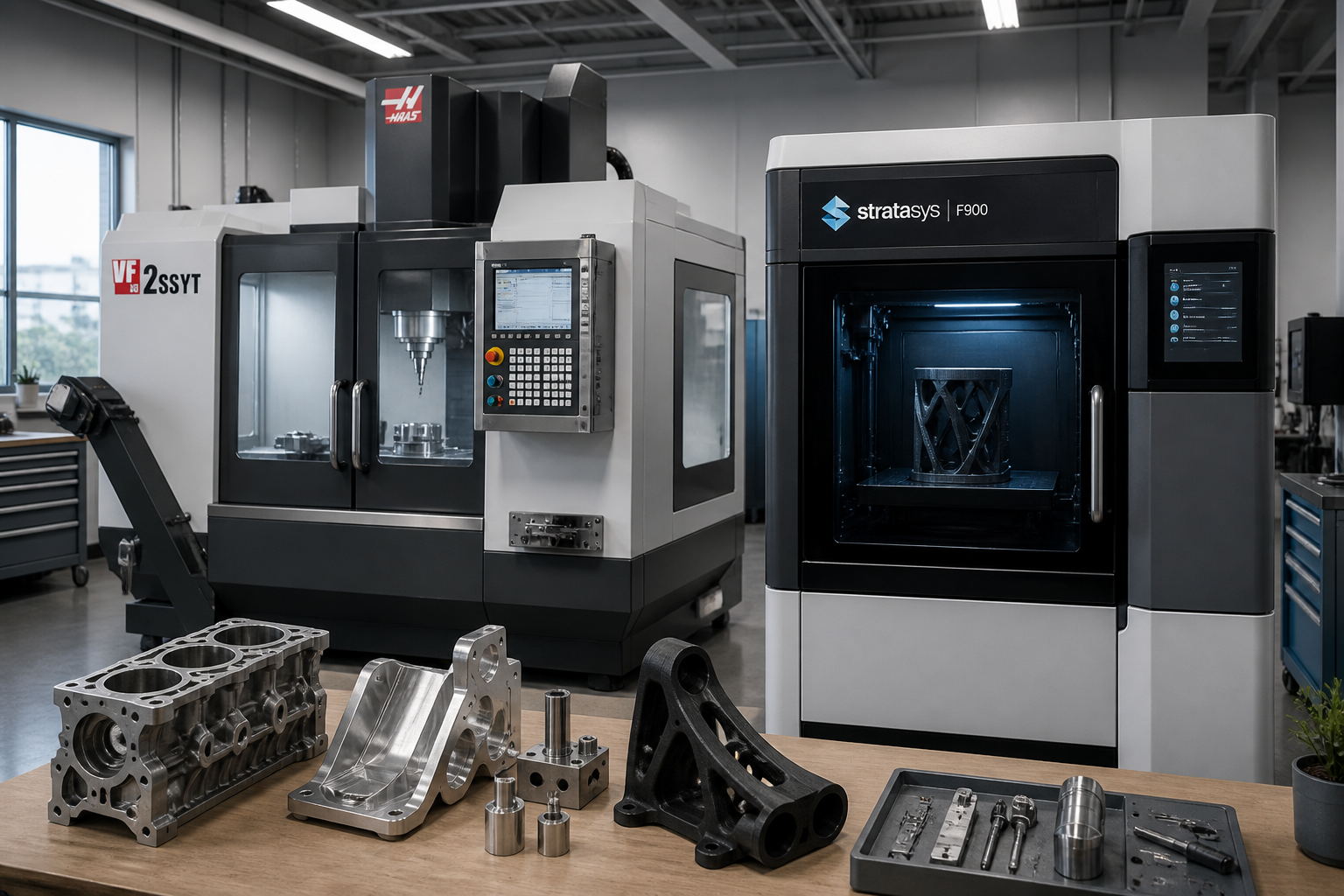
The core philosophy of hybrid manufacturing is "letting the right process do the right job"—using 3D printing to manufacture complex-shaped sections and CNC machining to ensure precision and surface quality. A typical hybrid manufacturing workflow includes: 1) using 3D printing to produce the part's Near Net Shape, incorporating all complex features (such as internal cavities, flow channels, thin walls, and lattice structures); 2) reserving a CNC machining allowance (typically 0.5-2mm); 3) completing critical mating surfaces, high-precision holes, assembly datums, and other features through CNC machining; and 4) performing necessary post-processing (such as polishing, coating, or heat treatment).
The advantage of this strategy lies in the fact that the 3D printing component fully leverages design freedom, while the CNC component ensures the precision of critical dimensions; their combination achieves a "1+1>2" effect. For instance, for an aerospace engine nozzle with complex internal cavities, if machined entirely via CNC, it would need to be broken down into multiple components for separate machining and subsequent welding, resulting in high costs, long lead times, and low reliability; conversely, if manufactured entirely via 3D printing, the precision of critical mating surfaces would fail to meet requirements. By adopting hybrid manufacturing—using 3D printing to create the overall near-net shape and then using CNC for the finish machining of mating surfaces—the process can be completed within 2-3 weeks, reducing costs by 40% while delivering superior performance.
Cost-Benefit Analysis Methods
Deciding whether to adopt hybrid manufacturing requires a detailed cost-benefit analysis. Costs primarily include equipment depreciation, material costs, labor costs, post-processing costs, and quality inspection costs. For 3D printing, equipment depreciation is typically higher (industrial-grade SLM equipment costs approximately RMB 2-5 million), but material utilization is high and labor costs are low; for CNC machining, equipment depreciation is relatively lower (a 3-axis CNC costs approximately RMB 300,000-1 million), but material waste is significant and labor costs are high (requiring programming, fixturing, tool changing, etc.).
A practical cost analysis method is "break-even point analysis"—calculating the cost crossover point between 3D printing and CNC machining. Generally, for parts with simple structures and high volumes (>100 pieces), CNC machining is more economical; for parts with complex structures and low volumes (
Submit a model, drawing, image or written notes. Engineers will review material, process, finishing and delivery based on actual use.