
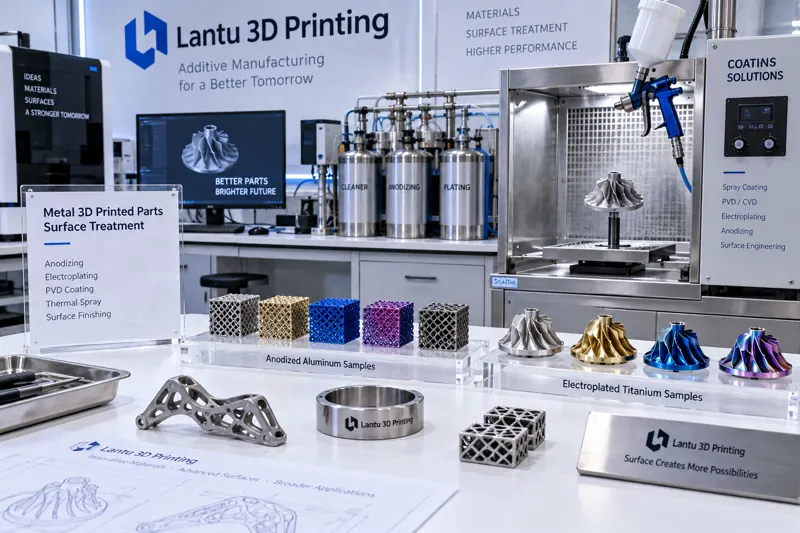
Introduction: Why Metal 3D Printed Parts Need Surface Treatment
Metal parts produced by laser powder bed fusion (SLM) can achieve internal densities above 99%, but their free surfaces often have roughness, unmelted powder residue, and open surface pores that cannot directly meet functional application requirements. In engineering indicators such as corrosion resistance, wear resistance, electrical conductivity, insulation, and appearance, as-printed parts almost always fall short. Surface treatment is a key step in turning a “printed” part into a “deliverable engineering component,” and it is also an underestimated bridge between additive manufacturing and end-use applications.
1. Surface Pretreatment: Make the Surface Clean, Smooth, and Controllable First
The original surface roughness Ra of SLM parts is usually between 6 and 12 μm, with balling particles and support remnants. Before any subsequent treatment, sandblasting, shot peening, or manual grinding should be used to reduce Ra to 1.6–3.2 μm, while thoroughly removing support residues and unmelted powder. Special attention should be paid to the fact that metal 3D printed parts commonly have open surface pores. During pretreatment, ultrasonic cleaning with alcohol or alkaline cleaning agents must be used to flush powder out of the pores; otherwise, plating solutions or sealing agents may remain inside the pores and become long-term corrosion sources.
2. Anodizing: Mainly for Aluminum Alloys, Balancing Insulation and Corrosion Resistance
Printed aluminum alloy parts such as AlSi10Mg and 6061 are most suitable for sulfuric acid anodizing, which can form a 5–25 μm aluminum oxide film on the surface, significantly improving corrosion resistance and surface insulation while also allowing decorative effects through dyeing. Key process points include sealing open surface pores first, controlling the oxidation voltage at 12–20 V, and maintaining the electrolyte temperature at 15–22°C. When the film thickness exceeds 20 μm, brittleness and dimensional growth must be evaluated. Although TC4 titanium alloy can also be anodized for coloring, its oxide film is thin and weakly bonded to the substrate, so special processes and film thickness control are required; aluminum alloy parameters cannot be applied directly.
3. Electroplating and Electroless Plating: Copper, Nickel, and Silver Improve Conductivity and Wear Resistance
316L stainless steel and TC4 titanium alloy have highly chemically inert surfaces, making direct electroplating prone to peeling. The correct sequence is to remove oil and oxide layers first, treat the surface with a dedicated activator, and then apply a flash-plated base metal layer. Electroless nickel plating can produce a uniform 3–10 μm coating on complex internal cavities and irregular surfaces, with hardness reaching 500–600 HV and significantly improved wear resistance. The key risks are trapped solution in pores and hydrogen embrittlement: after plating, high-temperature dehydrogenation must be performed, such as holding at 200°C for 2–4 hours, and through holes and blind holes must be properly sealed to prevent plating solution residue from causing pitting corrosion.
4. Spraying and Coatings: Combining Thermal Barriers, Wear Resistance, and Appearance
Plasma spraying, arc spraying, electrophoretic coating, and powder coating are often used for wear resistance, corrosion protection, or appearance uniformity. For hot-end parts requiring thermal insulation, zirconia thermal barrier coatings can be applied. For appearance parts, electrophoretic or powder coating can cover printing layer lines. It is important to note that thermal spraying introduces heat input, which may deform thin-walled or cantilever structures. Before spraying, fixturing and thermal deformation simulation should be carried out, and coating thickness tolerance should be controlled within ±0.05 mm.
5. Passivation and Passive Films: The Corrosion Resistance Baseline for Stainless Steel and Titanium Alloys
After nitric acid or citric acid passivation, 316L stainless steel forms a dense chromium-rich Cr2O3 passive film on the surface, increasing pitting potential by more than 200 mV. This is a mandatory process for medical devices and food-contact components. After heat treatment, TC4 titanium alloy forms an oxygen-rich alpha case on the surface, which must be removed by pickling and passivation; otherwise, it will affect subsequent coating adhesion and fatigue performance. Passivation is not a case of “the stronger, the better.” Excessive concentration or temperature can instead damage film continuity.
6. Process Selection Decisions and Common Pitfalls
Selection should follow the sequence of “material—function—service environment—cost”: aluminum alloys should prioritize anodizing; conductive and wear-resistant parts should use electroless nickel plating; corrosive environments call for passivation; and appearance or thermal insulation requirements favor spraying. The four most commonly overlooked pitfalls are delayed corrosion caused by trapped liquid in pores, assembly dimensional out-of-tolerance caused by coating thickness, brittle fracture of high-strength parts caused by hydrogen embrittlement, and insufficient adhesion resulting from incomplete pretreatment. Incorporating surface treatment into DFM review is the fundamental way to avoid delivery rework.
Conclusion
Surface treatment is the final mile for metal 3D printing to move from prototypes to engineering delivery. Only by understanding the compatibility boundaries between different materials and processes, and by properly controlling pretreatment and pore sealing, can stable and reliable results be achieved across corrosion resistance, wear resistance, conductivity, and appearance.
Submit a model, drawing, image or written notes. Engineers will review material, process, finishing and delivery based on actual use.