
Introduction: Why "Rephrasing the Reminder" Cannot Prevent Recurring Defects
In make-to-order manufacturing workshops, one category of rework is particularly persistent: the cause of a defect is documented in a report, discussed in team meetings, and added as a note in work instructions, yet the same error reappears two or three months later. The root cause is not that employees are insufficiently careful, but that control measures remain at the level of "reminders"—reminders depend on sustained human attention, and attention inevitably declines during repetitive work. The poka-yoke approach shifts quality judgment from "people remembering" to "making errors structurally impossible," so that errors are blocked by physical or logical conditions before they occur. This article discusses how to connect poka-yoke design, standard work, and work-order execution into an auditable shop-floor control system in hybrid additive manufacturing and post-processing workshops.
1. Levels of Poka-Yoke: From Warnings to Physical Prevention
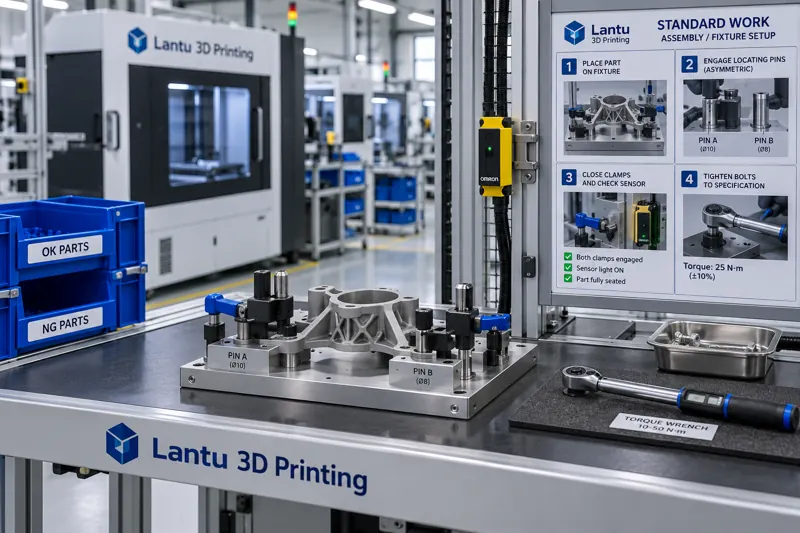
Poka-yoke is not a single tool, but a set of control measures classified by interception strength. The first level is the warning level, such as color labels, visual management boards, and system pop-ups. It is low-cost but depends on human response, and its interception rate is generally below 70%. The second level is the control level, where the system prevents the process from continuing after an error occurs. For example, a print work order cannot be started unless the powder batch number has been scanned and linked, or the furnace unload button remains disabled if the thermal profile has not reached the specified holding time. The third level is the physical level, which uses design features to make incorrect assembly or fixturing impossible: locating pins are arranged asymmetrically so that a part can be installed in only one orientation; quick-change connectors for different materials use different thread specifications; and fixtures include interference blocks so that reverse placement cannot be clamped. The priority for shop-floor improvements should be as follows: any defect that recurs more than twice should be elevated to at least the control level; issues involving safety or irreversible loss should be addressed directly with physical-level prevention.
2. Typical Failure Points and Poka-Yoke Designs in Additive Manufacturing Workshops
Powder bed fusion processes have several highly recurring failure points that warrant dedicated poka-yoke design. The first is misuse of powder batches and sieving status: recycled powder may be used for printing after exceeding its allowable reuse count, resulting in increased oxygen content and balling. A control measure is to install a scan-code interlock between the powder hopper and feed cylinder. If a powder container exceeds its reuse limit or its maximum allowable standing time after the last sieving operation, the system rejects powder feeding and instructs that it be reassigned to downgraded applications. The second is build plate and material grade mismatch: preheating temperatures for build plates of different alloys can differ by more than 100°C, and a mismatch can directly cause warping or poor bonding. Using mechanical coding pins on the build plate together with confirmation reading on the equipment side is the most direct physical-level poka-yoke measure. The third is confusion between support removal and datum surfaces: accidentally damaging a datum surface while removing supports causes subsequent CNC finish machining to lose its reference. A poka-yoke solution is to mark non-machined surfaces with distinct color codes at the model stage and install shielding guards on support-removal fixtures. The fourth is skipped post-processing steps: if the sequence of stress-relief annealing, sandblasting, and machining is interrupted or skipped, both performance and dimensions can become uncontrolled. A process routing card combined with scan-based reporting at every step can turn skipped operations into system-visible exceptions.
3. Standard Work: Converting Experience into Executable Minimum Units
For poka-yoke to be implemented effectively, standard work must serve as its vehicle. The three elements of standard work are takt time, work sequence, and standard work-in-process inventory. In additive manufacturing workshops characterized by customized orders and small batch sizes, unstable takt time is normal. A more practical approach is therefore to first standardize work sequences and inspection points, and then gradually stabilize takt time. Work instructions should be written in a three-part format of "action—acceptance criteria—exception handling": actions should specify techniques and parameters in detail, such as "use a torque wrench to tighten crosswise in two passes at 8 N·m"; acceptance criteria should provide measurable limits, such as "flatness ≤0.05 mm; if out of tolerance, transfer to process engineering"; and exception handling should identify the first responder and escalation path. Instructions should be limited to one page; tasks exceeding one page should be divided into multiple workstations. The key point is that standard work is not a one-time document, but a living document that is continuously revised as exceptions occur. Every closed loop for a recurring defect must be written back into the work instructions; otherwise, poka-yoke measures will become diluted over time.
4. Work-Order Execution and the Data Closed Loop
The most difficult part of paper-based systems is verifying execution. Embedding poka-yoke points into the work-order system is a low-cost and effective method: each work order should contain mandatory fields at critical process steps, and production reporting cannot be completed if they are left blank or exceed threshold values. At a minimum, production-reporting data should record five items for subsequent traceability: equipment number, operator, batch number, actual measured values of critical parameters, and disposition result. Once an exception is triggered, it enters the nonconforming product control process and follows a seven-step closed loop of "discovery—isolation—disposition—handling—cause—corrective action—verification." A verification window should be established in step seven—for example, no recurrence across three consecutive batches or within two weeks—before the case may be closed. Management should not focus on the total number of defects, but on the percentage of recurring defects and the on-time verification rate of corrective actions. The former indicates whether poka-yoke is effective, while the latter indicates whether the closed loop is honest. A sustained decline in the percentage of recurring defects shows that controls are shifting from "reminding people" to "constraining the system."
5. Implementation Path and Common Pitfalls
The recommended implementation sequence is as follows: first, compile rework and customer complaint records from the past six months, rank them by frequency, and select the top five defect types; conduct a failure-chain analysis for each type to identify the physical location where the error actually occurs; implement control-level or physical-level poka-yoke at the shortest intervention point; revise work instructions simultaneously and include poka-yoke points as mandatory work-order fields; and finally, establish a verification window and write the results back into the system. There are three common pitfalls. First, treating poka-yoke as a punitive performance assessment causes exceptions to be concealed and eliminates opportunities for improvement. Second, failing to verify effectiveness after installing a poka-yoke device: sensor drift or mechanical wear can silently degrade a "control-level" measure into a "warning-level" measure, so poka-yoke devices themselves must be included in regular inspections. Third, pursuing complete coverage all at once. The correct approach is to address only one of the top five defect types at a time, verify the results, and then move on to the next type.
Conclusion
The value of poka-yoke lies not in eliminating every error, but in intercepting errors before they occur and exposing exceptions within the system. For 3D printing workshops focused on high-mix, low-volume production, standardization and poka-yoke are prerequisites for scalable delivery: only when shop-floor operations can be described, verified, and constrained can delivery lead times and quality levels be reliably committed. Start with the most frequent defect type, use control-level measures together with mandatory work-order fields to establish the first closed loop, and replicate the approach across other processes after the verification window has been successfully completed.
Invia un modello, un disegno, un'immagine o note scritte. Gli ingegneri valuteranno materiale, processo, finitura e consegna in base all'uso effettivo.