Introduction: A Quotation Is Not Just a Price Sheet
In non-standard, custom 3D printing applications, quotations are often treated as a “price list for the customer”: a number is entered and the document is sent. In actual delivery, however, many disputes do not result from whether the price is high or low, but from the quotation failing to specify which model version, which material batch, which post-processing steps, how long the price remains valid, and under what conditions it no longer applies. When a customer uses the same quotation three months later and requests a repeat order at the original price, or revises a drawing midway through the project while insisting that “the quotation has not changed,” disputes become unavoidable. Managing quotations as engineering documents essentially means translating commercial commitments into verifiable and traceable technical terms.
I. Quotation Field Structure: Making Every Item Costable
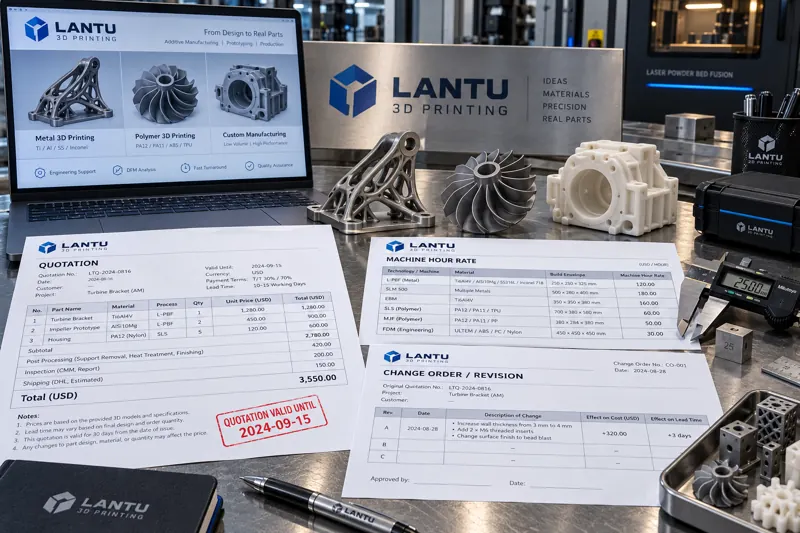
A traceable 3D printing quotation should include more than “unit price × quantity”; it should contain at least five groups of fields. The first is model and version information: file ID, revision number, modeling software and export format, triangle count or solid-model validation result, part volume, and bounding-box dimensions. The second is material and process information: material grade, process type, layer thickness, powder or resin batch number, and whether reclaimed powder is used and its maximum permitted proportion. The third is quantity and batch information: first-article quantity, production quantity, whether shipments are split into batches, and permitted batch-consolidation rules—because machine time per part is directly related to nesting efficiency within a build, and the per-part machine time for 10 parts versus 100 parts often differs by 30% to 50%. The fourth is post-processing and inspection information: support removal, sandblasting, heat treatment, machining, surface roughness targets, dimensional inspection methods, and report format. The fifth is delivery and responsibility information: order lead-time start point, packaging method, transportation responsibility, acceptance criteria, and nonconformance handling. Only complete fields provide a basis for costing; when fields are missing, every subsequent discussion merely fills another gap.
II. The Costing Sheet: Quantifying Materials, Machine Time, and Post-Lavorazione
The quotation provides the total price, while the costing sheet explains where that total comes from; the two must be issued together. A costing sheet should be structured into six segments: direct materials, machine time, post-processing, inspection, packaging and logistics, and risk and margin. The material calculation basis is part volume multiplied by material density, then multiplied by a process factor that includes supports and scrap, plus non-recoverable loss. For 316L stainless steel produced by laser powder bed fusion, for example, density is approximately 7.9 g/cm³. Although unfused powder can be reclaimed, it must be sieved and its oxygen content monitored during every cycle; the reclaimed-material proportion is typically capped at 30% to 50%, with any excess priced as virgin powder. The machine-time segment is the equipment hourly rate multiplied by estimated build time. Build time can be calculated from volumetric build rate or estimated from powder recoating and scan time per layer multiplied by the number of layers. The equipment hourly rate must include depreciation, facility overhead, energy consumption, and maintenance; calculating only electricity costs will systematically underestimate the true cost. Post-lavorazione and inspection should specify labor time and unit price for each operation, with heat treatment allocated by furnace cycle and coordinate measuring machine inspection charged by the number of inspected features. Once the six segments use consistent calculation rules, any price movement can be traced to the specific segment that changed.
III. Validity Periods and Assumptions: Converting Uncertainty into Terms
3D printing quotations depend heavily on the model revision, volume range, and material market conditions. Therefore, a validity period cannot simply state a date; it must be tied to assumptions. These assumptions should be explicitly listed: material price basis, exchange-rate basis, quantity range, drawing revision, powder batch rules, and production scheduling window. Validity periods should also be tiered: a standard validity period of 30 days applies when the drawing and quantity remain unchanged; after 30 days, material prices and machine-time scheduling must be reviewed; and if any assumption changes, the quotation automatically expires and triggers re-costing. This gives customers conditional certainty rather than a commitment that appears fixed but continuously shifts during execution. It also protects the service provider by turning a “price increase” from a subjective decision into an objective outcome triggered by defined rules.
IV. Changes and Additional Charges: Quantified Records for Scope Creep
Changes are almost inevitable in non-standard projects. The issue is not the change itself, but whether it is quantified. A change order using the same numbering system as the quotation should be established to record the change ID, initiating party, change details, which costing-sheet segments are affected, cost and lead-time increments, customer approval, and timestamps. Common additions include increased wall thickness, which raises both material use and machine time; added threaded holes or mating surfaces, which require additional machining; higher surface-roughness requirements, which increase polishing cycles; and a shift from single-part prototyping to small-batch production, which requires new nesting and first-article qualification. Every additional item should correspond to a specific line in the costing sheet rather than being broadly labeled “price to be negotiated.” Changes without change orders will ultimately become uncompensated additions that quietly consume the margin of the entire order. A practical approach is to establish a free-change threshold—for example, cumulative cost increases of no more than 3% of the original quotation and no more than one day of lead-time impact. Any change exceeding that threshold requires a change order and re-costing.
V. Implementation Checklist
Engineering-based quotation management can begin with six checklist items: whether the quotation includes the model revision and file ID; whether it specifies material grade, process type, layer thickness, and batch rules; whether the costing sheet contains all six segments and each can be traced to unit rates and labor time; whether the validity period is linked to assumptions; whether change-order templates and approval processes are in place; and whether quotations, costing sheets, and change orders use unified numbering and are archived for direct retrieval in repeat orders. These six measures do not require additional software investment; they can be implemented with a numbering convention and two document templates.
Conclusion
The quotation, costing sheet, and change order form the minimum traceable commercial closed loop for 3D printing services: the quotation establishes external commitments, the costing sheet provides internal justification, and the change order records deviations. When these documents are managed as engineering records, every price adjustment has a source, every dispute review has evidence, and repeat orders no longer need to be estimated from scratch. Customers receive clear boundaries instead of vague figures, while service providers protect margin rather than relying on luck.
Invia un modello, un disegno, un'immagine o note scritte. Gli ingegneri valuteranno materiale, processo, finitura e consegna in base all'uso effettivo.