
Introduction: Machines Are Busy, but Orders Are Still Late
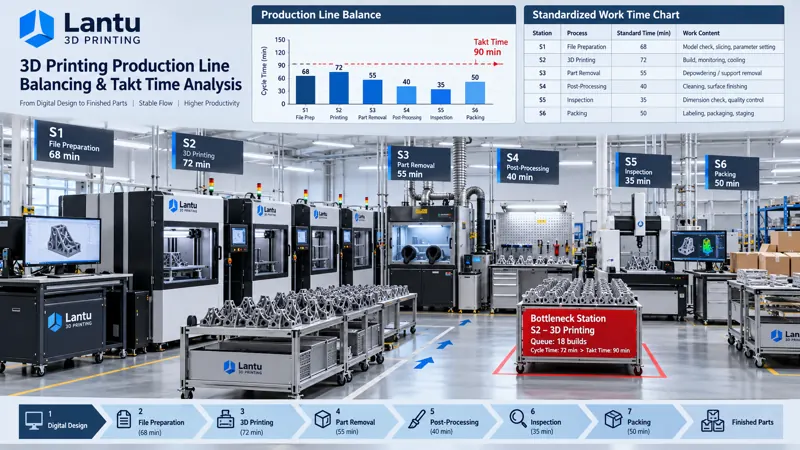
In many 3D printing factories, a typical situation occurs: printing equipment appears to have a high operating rate, yet parts waiting for post-processing pile up year-round in front of downstream workstations. Depowdering, support removal, blasting, heat treatment, and inspection all form queues, while delivery dates are repeatedly pushed back. Managers often attribute this to insufficient capacity and continue purchasing more machines. As a result, work-in-process keeps increasing, but on-time delivery does not improve.
The root cause is usually not the speed of a single machine, but line balance. Additive manufacturing is a multi-step process chain consisting of printing, depowdering, support removal, post-processing, inspection, and packaging. The takt time of each process can differ dramatically: a laser powder bed fusion machine may run continuously for more than ten hours, while support removal and surface finishing for a complex part may take only several dozen minutes. If tasks are allocated simply according to the number of machines, accumulation will inevitably form in front of the slowest process. This article presents a practical engineering method for 3D printing workshops, from standard time measurement and bottleneck identification to line balance rate calculation and takt optimization.
1. Why Takt Time Is Especially Difficult to Balance in 3D Printing Workshops
In conventional machining workshops, process takt times are relatively even. In additive manufacturing, however, takt distribution is highly uneven, mainly due to three factors.
First, process durations differ by orders of magnitude. A single build cycle in metal laser powder bed fusion (LPBF) often takes 8 to 30 hours, while depowdering and support removal for the same batch may take only 1 to 3 hours. If labor and equipment are configured at a 1:1 ratio, the slower process will inevitably become the bottleneck.
Second, batch size and build layout strategy are tightly coupled. One build can contain dozens of small parts or just one large part. Nesting density determines the printing time allocated to each part and also determines the arrival rhythm of downstream processes. Once the build strategy changes, the takt distribution of the entire line changes with it.
Third, post-processing time is highly dependent on part geometry. Within the same batch, parts with complex internal channels may require three to five times more depowdering and abrasive flow machining time than simple external-geometry parts. If production planning is based on average time, actual variation will repeatedly break the schedule.
These three characteristics mean that line balancing in a 3D printing workshop cannot simply copy assembly-line experience. It must be based on measured standard times and modeled by part family.
2. Methods for Measuring Standard Time
Standard time refers to the time required for a qualified operator to complete a unit operation under standard working conditions. It is usually derived by correcting observed time with a performance rating factor and an allowance factor:
Standard time = Average observed time × Performance rating factor × (1 + Allowance rate)
In a 3D printing workshop, it is recommended to establish separate time models by process.
Printing process: Time is mainly machine occupation time, supplemented by manual intervention such as powder spreading checks, chamber cleaning, and build exchange. It is advisable to distinguish between machine time and labor time: the former is used for capacity calculation, while the latter is used for manpower allocation. For example, if one build on a machine takes 14 hours and manual intervention takes 0.8 hours, the machine time is 14 hours per build, and the labor time is 0.8 hours per build.
Depowdering and support removal processes: Time is strongly related to part volume, internal-cavity complexity, and support volume. It is recommended to take measured samples by part family and establish regression relationships. In practice, continuous stopwatch observation can be used. Each part should be observed at least 5 to 10 times and averaged. After removing outliers, the result is multiplied by the performance rating factor, typically 0.95 to 1.10.
Post-lavorazione and inspection processes: Blasting, polishing, heat treatment, coordinate measuring machine inspection, and similar operations are clearly affected by batch size and often involve significant setup time. They should be split into setup time and per-part time: Total process time = Setup time + Per-part time × Batch size.
The recommended allowance rate is 8% to 20% depending on work intensity. Positions involving dust protection and material handling should use a higher value, while seated precision work can use a lower value. Allowance includes personal allowance, fatigue allowance, and process allowance; it should not be simplified into one uniform number for all operations.
3. Identifying Bottleneck Processes
Once standard times for each process are available, bottleneck identification has an objective basis rather than relying on shop-floor intuition. Three methods are commonly used.
Method 1: Compare process load rates. Calculate the daily load rate of each process = labor hours required for planned tasks ÷ available hours. The process with the highest load rate that consistently exceeds 100% is the bottleneck. In 3D printing workshops, bottlenecks often appear in depowdering, support removal, or heat treatment.
Method 2: Observe queue length. Observe continuously for one week and record the amount of work-in-process (WIP) accumulated before each process. If accumulation in front of a process continues to grow, the upstream arrival rate is higher than its processing capacity. This is the most intuitive method and the easiest for shop-floor personnel to accept.
Method 3: Analyze overall equipment effectiveness (OEE). If the OEE of a bottleneck process is already close to its theoretical limit, there is little room to improve efficiency simply within that process. Diversion through process changes or production scheduling is then required.
It is important to note that bottlenecks can shift. When the order mix changes from large parts to small parts, the bottleneck may move from printing to post-processing. After automated depowdering equipment is introduced, the bottleneck will be redistributed again. Therefore, bottleneck identification should be reviewed monthly rather than measured once and used indefinitely.
4. Calculating and Improving the Line Balance Rate
The line balance rate is an indicator used to measure how evenly workload is distributed across processes:
Line balance rate = Sum of standard times for all processes ÷ (Bottleneck process time × Number of processes) × 100%
The higher the balance rate, the closer the workloads of all processes are, and the less waiting and WIP will occur. In general discrete manufacturing, the target line balance rate is above 85%. In a 3D printing workshop, because process durations differ so greatly, reaching 60% to 70% in the early stage is already normal. Improvement potential is mainly released through the following measures.
1. Split and merge processes. Separate standardized portions from the bottleneck process. For example, rough support removal and precision finishing can be split. Rough removal can be handled centrally by dedicated personnel, while precision finishing remains on the main line, significantly reducing bottleneck time.
2. Prioritize bottleneck-driven scheduling. Use a bottleneck-driven scheduling logic: schedule the bottleneck process first, then pull upstream processes and push downstream processes according to the bottleneck rhythm. High local efficiency in non-bottleneck processes is meaningless; only bottleneck output determines total line output.
3. Set buffers instead of allowing uncontrolled stockpiling. Establish a fixed-quantity buffer before the bottleneck process, usually based on 2 to 4 hours of bottleneck processing volume, rather than allowing unlimited accumulation. When the buffer is full, upstream release should stop to prevent WIP from getting out of control.
4. Coordinate build strategy with takt time. Link build layout planning with downstream processing capacity. When post-processing is the bottleneck, prioritize grouping part families with low post-processing time into the same builds. When printing is the bottleneck, increase nesting density to reduce printing time per part.
5. Develop multi-skilled operators. Assign operators with multi-process capabilities to bottleneck processes. When accumulation occurs at the bottleneck, personnel can be temporarily transferred from adjacent processes to provide support. This is the lowest-cost method for increasing operational flexibility.
5. Implementation Points and Common Pitfalls
When implementing line balance management, several frequent pitfalls should be avoided in advance.
Pitfall 1: Replacing part-family time with average time. Using one average depowdering time for all parts leads to overly optimistic scheduling for complex parts. Time models must be established by part family, at least distinguishing between simple external geometry, medium complexity, and complex internal cavities.
Pitfall 2: Looking only at machine uptime. High uptime does not equal high output. If the bottleneck is downstream, the higher the printing equipment uptime, the faster WIP accumulates. A production line should be evaluated by on-time delivery rate and WIP turnover days, not by utilization of a single machine.
Pitfall 3: Measuring time once and treating it as permanent. Process parameter adjustments, equipment upgrades, and improved operator proficiency all change work time. Standard times should be reviewed quarterly, and any process change must trigger remeasurement.
Pitfall 4: Forcibly splitting processes just to improve the balance rate. Excessive splitting increases transfer and waiting time, reducing efficiency instead. The prerequisite for splitting is that the separated portion can be standardized and that transfer cost remains controllable.
The recommended implementation sequence is to first establish the process list and time models, then identify bottlenecks, then improve the bottleneck, and finally track results using both the line balance rate and the on-time delivery rate. Do not attempt to roll out everything comprehensively from the beginning.
Conclusion
Delivery pressure in 3D printing workshops is usually not caused by a lack of equipment, but by WIP accumulation resulting from imbalanced process takt times. The solution path is to replace experience-based estimates with measured standard times, identify bottlenecks objectively through load rates and queue lengths, control WIP through bottleneck-driven scheduling and fixed-quantity buffers, and continuously track improvement through the line balance rate. For a lifecycle management platform covering the full process from blueprint design to physical delivery, line balance data also forms the underlying basis for quotation, production scheduling, and delivery commitments. Only when time is measured accurately can delivery dates be promised with confidence and costs be calculated clearly.
Invia un modello, un disegno, un'immagine o note scritte. Gli ingegneri valuteranno materiale, processo, finitura e consegna in base all'uso effettivo.