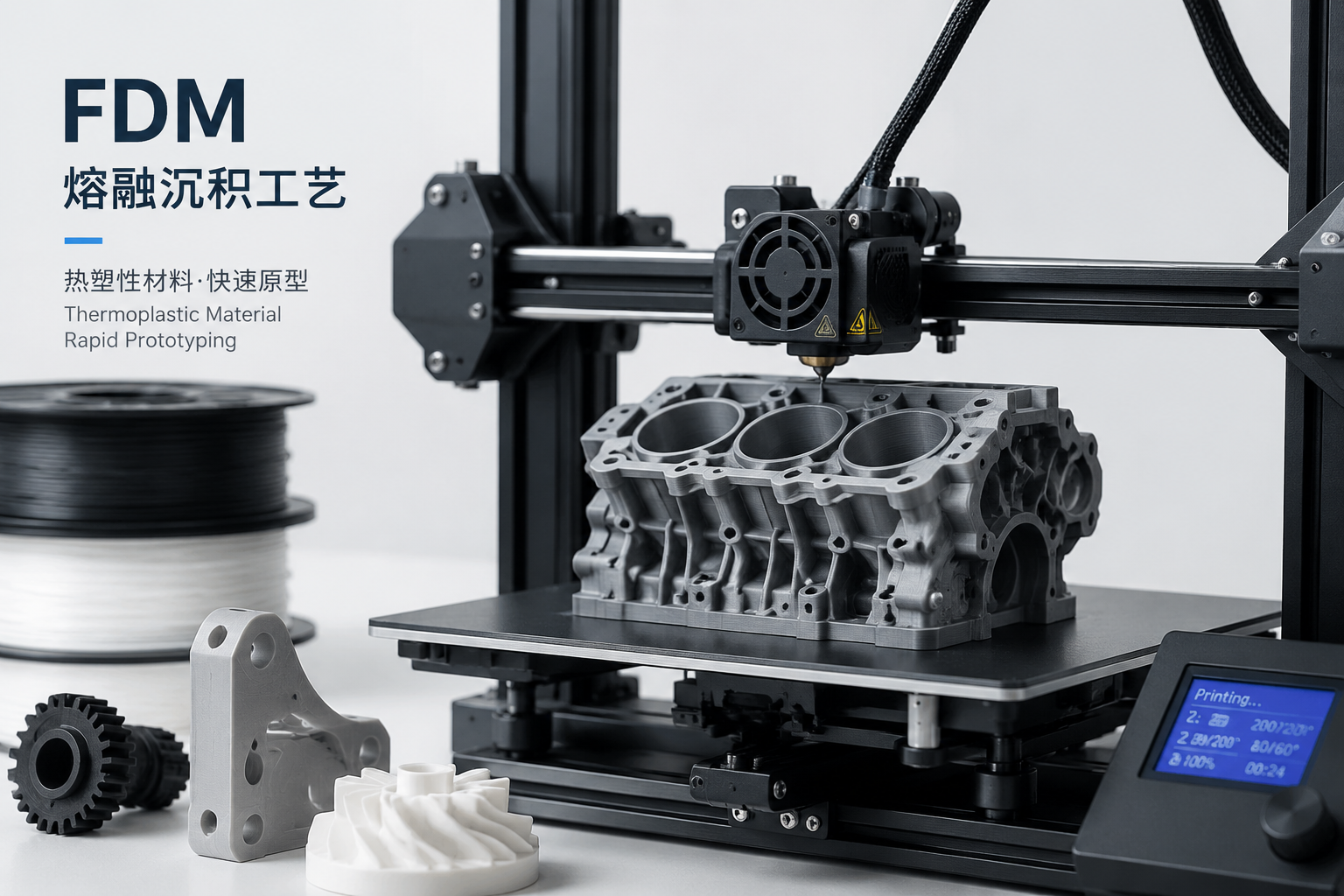
FDM Fused Deposition Modeling
FDM is the most widespread 3D printing technology, extruding thermoplastic filament layer by layer.
Working Principle
Filament feeds into heated nozzle (180-300°C), melts and extrudes through 0.2-0.8mm nozzle, deposits on build platform layer by layer.
Key Parameters
- Layer height: 0.05-0.4mm
- Accuracy: ±0.2mm
- Nozzle diameter: 0.2-0.8mm
- Print speed: 40-150mm/s
- Max build volume: 1000×1000×1000mm (industrial)
Compatible Materials
PLA, ABS, PETG, TPU, Nylon PA, carbon fiber reinforced, PEEK, ULTEM.
Pros & Cons
- Pros: low cost, wide material range, easy operation, large format
- Cons: visible layer lines, support needed for overhangs, lower accuracy than SLA, anisotropic Z-strength
Typical Applications
Functional prototypes, jigs and fixtures, large parts, architectural models, education.
Next Step
Is this close to what you need?
Submit a model, drawing, image or written notes. Engineers will review material, process, finishing and delivery based on actual use.