SLA Process
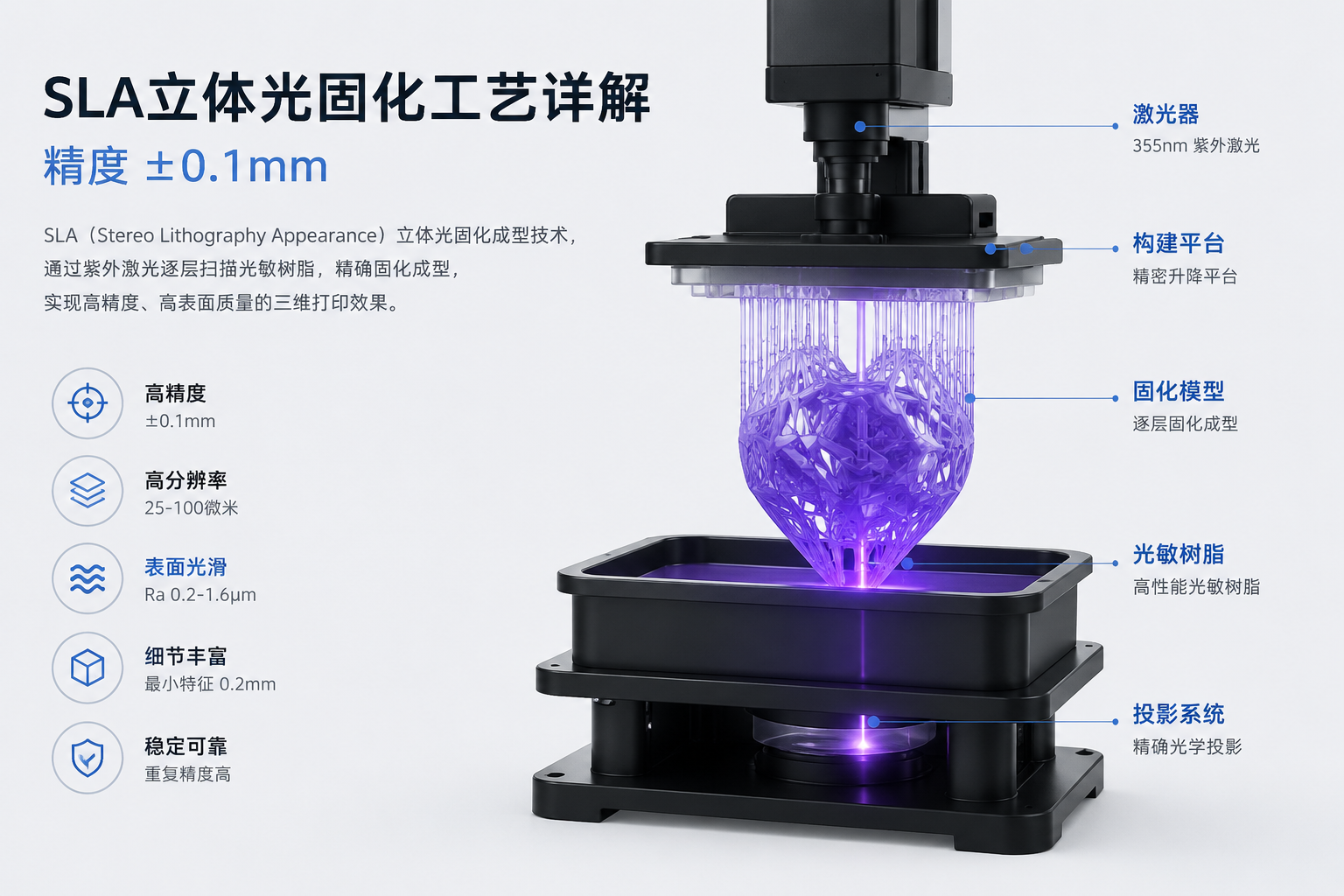
SLA (Stereolithography) is the earliest commercialized 3D printing technology, using UV laser to cure photopolymer resin layer by layer.
Working Principle
UV laser (355nm) scans the resin vat following cross-section contours, curing exposed areas. The platform descends incrementally, building layer by layer.
Key Parameters
- Layer height: 0.025-0.1mm
- Accuracy: ±0.05mm (or 0.05mm/25mm)
- Print speed: 40-60mm/h (Z-axis)
- Max build volume: 600×600×400mm
Compatible Materials
Standard resin, tough resin, high-temp resin, transparent resin, flexible resin, castable resin.
Pros & Cons
- Pros: high precision, smooth surface, excellent detail
- Cons: brittle (standard resin), post-curing required, support removal needed
Typical Applications
Appearance models, fine details, jewelry wax patterns, dental models, optical clear parts.
Next Step
Is this close to what you need?
Submit a model, drawing, image or written notes. Engineers will review material, process, finishing and delivery based on actual use.