Introduction: The key role of heat treatment in the 3D printing process chain
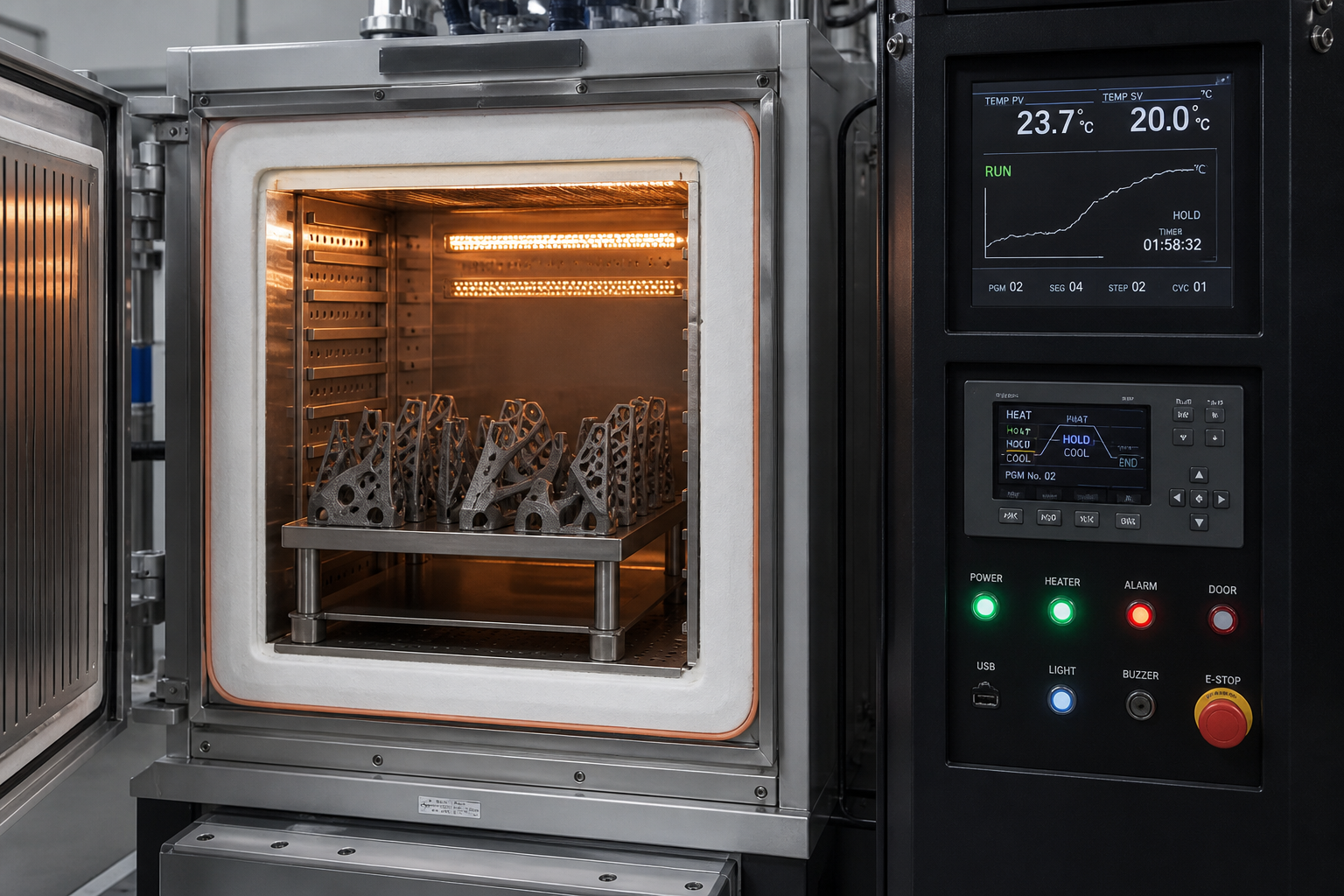
During the molding process of 3D printed parts, significant thermal stress and residual stress often accumulate inside due to rapid heating and cooling cycles. These stresses not only affect the dimensional stability of the part, but can also lead to problems such as warping, cracking, and loss of strength. Heat treatment is a key link in the 3D printing post-processing process chain. By accurately controlling heating temperature, holding time and cooling rate, internal stress can be effectively eliminated and the microstructure can be optimized, thereby significantly improving the comprehensive mechanical properties of the part.
Different 3D printing processes rely on heat treatment to varying degrees. Due to the extremely high temperature gradient and cooling rate during the molding process of metal 3D printing (SLM, EBM, DED), almost all printed parts require appropriate heat treatment to meet the requirements of engineering applications; polymer printed parts (FDM, SLS, SLA) are selectively annealed or cured according to material properties and application scenarios. This article will systematically introduce the heat treatment process of various types of 3D printing materials, from basic principles to practical operations, providing a reference for enterprises to establish a complete post-processing system.
Stress relief annealing of metal 3D printed parts
Stress relief annealing of metal 3D printed parts is the most widely used heat treatment process. Taking aluminum alloy (AlSi10Mg) as an example, the residual stress of printed parts can reach 50%-80% of the material's yield strength. If stress relief is not performed, severe deformation may occur during subsequent machining. Stress relief annealing is usually held at 300°C-350°C for 2-4 hours, followed by slow cooling to room temperature in the furnace. For titanium alloy (Ti-6Al-4V), the stress relief temperature is usually 650°C-750°C, and the holding time is determined according to the wall thickness of the part.
The key parameters of stress relief annealing include heating rate, holding temperature and cooling rate. If the heating rate is too fast, the internal temperature gradient of the part will increase, which will introduce new thermal stress; if the holding time is insufficient, the residual stress cannot be fully released. The cooling stage is particularly important. Furnace cooling or controlled cooling rate must be used to avoid new stresses caused by rapid cooling. For large metal prints, it is recommended to use a segmented heating and cooling process to further reduce the impact of temperature gradients.
The choice of heat treatment atmosphere also affects the quality of parts. For active metals such as titanium alloys, heat treatment must be carried out in a vacuum or argon protective atmosphere to prevent high-temperature oxidation. Aluminum alloys can be processed in an air atmosphere, but attention needs to be paid to controlling the holding time to avoid a decrease in strength due to over-aging. The heat treatment process for stainless steel (316L, 17-4PH) is relatively forgiving, but precipitation hardening stainless steels require precise control of aging temperature and aging time to achieve the target strength grade.
Solid solution aging treatment and performance optimization of titanium alloy
Titanium alloy is the most widely used metal 3D printing material in the fields of aerospace and medical devices. Its heat treatment process directly determines the partsfinal performance. The printed structure of Ti-6Al-4V is usually acicular martensite, with high strength and hardness, but poor plasticity. Through solid solution treatment (950°C-1020°C, heat preservation for 1-2 hours, rapid cooling) and aging treatment (480°C-595°C, heat preservation for 4-8 hours), a dual-phase structure can be obtained, which can significantly improve the plasticity and toughness while maintaining high strength.
For 3D printing titanium alloys, heat treatment also needs to consider the characteristics of the printed structure. The printed grains show an epitaxially grown columnar crystal morphology, and the grain size and texture have a significant impact on performance. Through β annealing treatment (higher than β transformation temperature), the columnar crystal morphology can be eliminated, the equiaxed crystal structure can be obtained, and the fatigue performance can be improved. However, beta annealing will reduce the strength and needs to be balanced according to application requirements. Titanium alloy implants in the field of medical devices usually require complete annealing to obtain optimal biocompatibility and fatigue life.
The impact of heat treatment on the dimensional accuracy of titanium alloy printed parts requires special attention. The rapid cooling of solution treatment can cause part distortion, so critical dimensional areas need to be re-machined after heat treatment. It is recommended to reserve a machining allowance of 0.5-1mm in the design and carry out finishing after heat treatment. At the same time, the deformation during the heat treatment process can also be partially alleviated by optimizing the support structure and adjusting the placement direction during printing.
Heat treatment process of aluminum alloy and stainless steel
The heat treatment of aluminum alloy 3D printed parts mainly includes stress relief annealing, solution treatment and artificial aging. AlSi10Mg is a common cast aluminum alloy. The printed structure is a fine eutectic silicon network. After solid solution treatment (520°C-530°C) and artificial aging (155°C-175°C, heat preservation for 6-12 hours), the silicon phase spheroidizes and the mechanical properties are significantly improved. The tensile strength of AlSi10Mg in T6 state (solid solution + aging) can reach more than 330MPa, and the elongation increases to more than 8%.
Aluminum alloy heat treatment requires attention to the risk of over-aging. Aging temperature that is too high or time that is too long will lead to a decrease in strength, so the process window needs to be strictly controlled. In addition, the quenching transfer time of aluminum alloy parts after solution treatment should be as short as possible (generally no more than 15 seconds) to ensure the solution effect. For thin-walled aluminum alloy parts, quenching may cause deformation, and polymer quenching media can be considered instead of water quenching to reduce the cooling rate.
Among stainless steel 3D printed parts, 316L austenitic stainless steel usually only needs stress relief treatment (400°C-500°C, heat preservation for 1-2 hours) to meet most application requirements. 17-4PH precipitation hardening stainless steel requires solution treatment (around 1040°C) and aging treatment (480°C-620°C, selected according to the required strength level). Martensitic stainless steel (such as 420, 440C) needs to be annealed after printing to improve the machinability, and finally the target hardness is obtained through quenching and tempering. Stainless steel heat treatment has lower requirements for atmosphere, butIt is still recommended to carry out in a protective atmosphere to avoid the surface oxide layer from affecting subsequent surface treatment.
Annealing and curing treatment of polymer 3D printed parts
The heat treatment of polymer 3D printed parts cannot be ignored. Parts such as PLA and ABS printed by FDM have obvious anisotropy due to weak inter-layer bonding. Annealing treatment can effectively reduce residual stress and improve interlayer bonding strength. The annealing temperature of PLA parts is usually 60°C-90°C (close to the glass transition temperature), and the holding time is 30-60 minutes; the annealing temperature of ABS parts is 80°C-110°C. The size of the part may shrink or expand slightly after annealing, and compensation needs to be provided in the design.
The annealing treatment of nylon (PA12) SLS prints is special. During the SLS printing process, the unsintered powder plays a supporting role in the parts, and the parts may undergo slow crystallization shrinkage during the cooling process, resulting in dimensional changes. By annealing at 120°C-150°C, the crystallinity can be stabilized and dimensional stability improved. However, it should be noted that annealing will slightly increase the hardness and stiffness of nylon parts, while reducing the toughness, which needs to be considered comprehensively during design.
Post-curing of light-cured (SLA, DLP) resin prints is a critical step in achieving final performance. After printing is completed, there are still incompletely cured monomers inside the resin parts, which need to be post-cured in a UV curing box. Post-cure time is typically 30-90 minutes, depending on resin type and part thickness. Post-cure can significantly increase the strength, hardness and heat resistance of a part, but it can also cause shrinkage and deformation. For light-cured parts with high precision requirements, it is recommended to post-cure before support removal to reduce deformation. Some engineering resins also require thermal post-curing (60°C-80°C) to further increase the glass transition temperature.
Determination of heat treatment process parameters and quality verification
The determination of heat treatment process parameters requires comprehensive consideration of material grade, printing process, part size and performance requirements. It is recommended that when establishing a heat treatment process, companies refer to the recommended process windows provided by material suppliers and determine the best parameters through experimental verification. The experimental design can use the orthogonal experimental method to examine the influence of the three main factors of temperature, time and cooling rate on the mechanical properties. Performance verification of each batch of heat treated parts should include tensile testing, hardness testing and microstructural analysis.
Quality verification is a key link in the closed-loop control of the heat treatment process. The following inspections should be carried out after each batch of parts are heat treated: first, dimensional inspection to confirm that the deformation of the parts is within the allowable range; second, hardness test to verify the consistency of the heat treatment effect; third, microstructural inspection to confirm that there are no abnormal structures such as overheating and overburning; fourth, mechanical property testing, tensile tests and impact tests should be conducted on key parts. A ledger should be established for inspection data to form batch traceability records to provide data support for continuous process optimization.
Calibration and maintenance of heat treatment equipment are equally important. The uniformity of furnace temperature should be checked regularly (once a quarter is recommended) to ensure that the temperature deviation in the furnace is within ±10°C. Thermocouples need to be calibrated regularly, and the temperature recorder should be equipped with an over-temperature alarm function. For vacuum heat treatment furnaces, it is also necessary to regularly check the vacuum maintaining ability and atmosphere purity. Establishing a sound heat treatment equipment management system is the basis for ensuring the stability of heat treatment quality.
Conclusion: Heat treatment is the key to releasing the performance of 3D printed parts
Heat treatment plays an increasingly important role in the 3D printing process chain. For metal printed parts, heat treatment is almost an indispensable process, which directly determines the strength, plasticity and fatigue life of the part; for polymer printed parts, annealing and post-curing treatments can significantly improve dimensional stability and mechanical properties. Enterprises should establish a standardized heat treatment process system based on material characteristics and application requirements, and provide a complete quality verification process.
In the future, with the in-depth application of 3D printing in high-end manufacturing fields such as aerospace, medical equipment, and automobiles, the refinement and intelligence of heat treatment processes will become an important trend. New technologies such as in-situ heat treatment, integrated post-processing equipment, and heat treatment process design based on simulation optimization are developing rapidly. It is recommended that enterprises continue to pay attention to the forefront of heat treatment technology, incorporate heat treatment capacity building into 3D printing service capacity planning, and provide customers with complete process chain services from printing to performance release.
Submit a model, drawing, image or written notes. Engineers will review material, process, finishing and delivery based on actual use.