
Why 3D Printing Workshops Need Clear Work Orders
In many additive manufacturing workshops, the actual carriers of production instructions are not work orders in a system, but a few messages in a WeChat group, sticky notes on the print-room whiteboard, and priorities held in the team leader's mind. This model can function when there are fewer than five machines and no more than ten orders per day. But once the fleet grows to more than a dozen machines and concurrent orders exceed thirty or forty, information distortion becomes concentrated: the same part is loaded onto two machines, work orders lacking materials remain at the top of the queue, rush orders go untracked, and month-end reconciliation reveals that reported quantities do not match outbound quantities.
Production organization in 3D printing has its own characteristics. A single build chamber often contains multiple parts for multiple customers. Once nesting is determined, the progress of an individual part cannot be separated from the other parts in the same build. This means that a work order cannot merely describe “which part to make”; it must also specify “which parts are made together, in what sequence they are removed, and which are inspected first.” Converting these constraints into work-order fields is the first step in digitizing execution-level management.
The Minimum Set of Fields a Work Order Should Carry
An executable 3D printing work order should include at least several categories of fields. The first is identification fields: work-order number, customer order number, part number, revision number, and quantity. Revision numbers are especially likely to be omitted, yet they are the final safeguard against loading an outdated model onto a machine.
The second is process fields: machine type and machine ID, material grade and powder batch number, process parameter package ID, layer thickness, and the storage location of orientation and support-strategy files. The powder batch number must be recorded on the work order; otherwise, when a batch-related quality issue occurs, the traceability scope can only be expanded to “all parts produced during that period.”
The third is planning fields: planned machine-start time, planned completion time, estimated cycle time, priority, and rush-order flag. Cycle-time estimates should come from statistical historical actuals rather than verbal estimates from process engineers, so that scheduling results are comparable.
The fourth is readiness fields: model-file readiness status, reserved material inventory quantity, availability of tooling and fixtures, reservation status for post-processing operations, and reservation status for inspection resources. The essence of readiness verification is to clearly identify everything that is missing before the work order is issued.
Readiness Verification: Expose Material Shortages Before Machine Start
The inspection logic for readiness verification should be implemented as a hard system gate, rather than relying on individual discipline. It is recommended to assess five conditions one by one: the model file has passed printability validation and its revision is locked; the required material grade has available inventory after safety stock is deducted; the powder batch has passed moisture-content and flowability reinspection; capacity slots for post-processing operations, including support removal, heat treatment, and surface treatment, have been reserved; and inspection resources, such as CMMs, industrial CT scanners, and gauges, have spare capacity after the expected completion time.
If any condition is not met, the work order should not enter the dispatchable pool. Instead, it should move to a shortage list and automatically receive an assigned owner. Practical data show that workshops performing readiness checks before dispatch can reduce machine idle time caused by material shortages by 40% to 70%. This gain is often more immediate than the benefits of process optimization.
For work orders involving multiple parts in the same build, readiness verification should include one additional requirement: the planned completion times of all parts in the build must fall within the same post-processing window. Otherwise, one part may finish printing early but must wait for another part before they can undergo heat treatment together, turning the work-in-process staging area into a new bottleneck.
Dispatching: From “Whoever Is Available Does It” to Rule-Driven Allocation
The core of dispatching is allocation decisions. Three common methods are load balancing by machine, consolidation by material batch, and backward scheduling from delivery dates. Each rule has applicable conditions, and mature workshops usually use a weighted combination.
Machine-load balancing is suitable when machine capabilities are similar. Its goal is to keep cumulative operating time across machines as close as possible and avoid excessive wear on individual machines. Material-batch consolidation is suitable when powder-change costs are high: work orders using the same material grade and batch are grouped for consecutive production on the same machine, reducing chamber cleaning and powder-change frequency. A complete powder change and chamber cleaning often takes two to four hours, so consolidated production can release significant capacity.
Backward scheduling from delivery dates is used for rush orders and committed delivery-date management. The key parameter is the ratio of remaining days to delivery against remaining required labor hours. When this ratio falls below a defined threshold, an escalation alert should be triggered and the production supervisor should intervene to reschedule, rather than allowing team leaders to insert orders on their own.
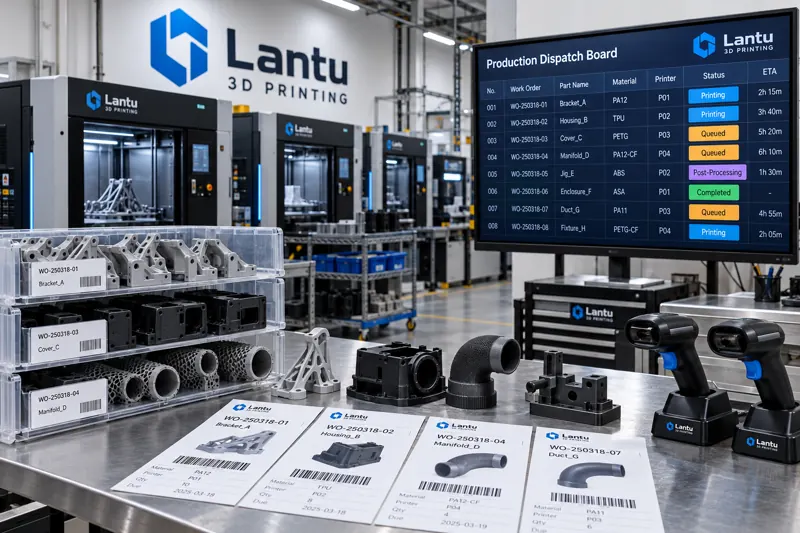
Dispatch results must be published to the workshop in the form of a visual management board, including each machine's current work order, queued work orders, estimated changeover time, and current status. The value of the board is not merely transparency; it enables abnormalities to be seen as soon as they occur.
Production Reporting: Actual Data Feedback Is the Last Mile of the Closed Loop
Production reporting is often reduced to “check the box when completed,” but truly valuable reporting should record at least four groups of data: actual start and finish times, accepted and rejected quantities, nonconformance reason codes, and actual consumption of equipment-related consumables.
The gap between actual labor time and standard time is a rich source of process improvement. When the actual time for a type of part consistently exceeds the standard by more than 15%, it usually means either the standard needs revision or the part's orientation and support strategy can be optimized. Conversely, actual time consistently below the standard indicates that the standard is too loose and delivery commitments are overly conservative.
Nonconformance reason codes should use a controlled vocabulary rather than free text. The vocabulary can be divided by stage into six categories: model issues, material issues, equipment issues, parameter issues, post-processing issues, and inspection-decision issues, with further subcategories under each. Only structured data can support subsequent Pareto analysis.
Consumable consumption records should not be omitted either. Inert-gas usage, powder replenishment quantity, and filter-element replacement frequency are not only the foundation of cost accounting but also supporting indicators of equipment-condition trends. Abnormally rising gas consumption often appears before an oxygen-content alarm.
Shift Handover and Exception Traceability
A 3D printing build cycle often spans multiple shifts. Loading may occur during one shift and unloading during another. Shift-handover records must therefore contain structured information: the list of work orders in process and the current stage of each, abnormalities occurring during the shift and corrective actions taken, equipment status changes such as protective-lens replacement and galvanometer calibration, as well as pending tasks and responsible persons.
Shift handovers should be mandatory forms within the system rather than verbal exchanges. Equipment status changes must be linked to specific work orders and timestamps, so that when quality variation in a batch of parts is analyzed later, it can be quickly determined whether the variation is related to maintenance performed during the build.
Exception traceability also includes implementing sample-retention rules. Retaining one witness coupon or same-batch sample part for each batch and registering it against the work-order number provides the only reliable physical evidence for later failure analysis.
Implementation Path and Common Mistakes
It is recommended that execution-level digitization be implemented in three steps. The first is field standardization: define what must be written on a work order, even if spreadsheets are still used. The second is readiness hard gating: stop shortages before machine startup. Only the third step is systematic dispatching rules and production-reporting analysis. Skipping the first two steps and implementing a system directly often results in fields that cannot be fully completed and data that no one trusts.
There are three common mistakes. First, turning work orders into approval workflows, where layer-by-layer signatures delay dispatching; a work order is an execution instruction, not a contract review. Second, designing too many reporting fields, causing operators to fill them in casually for convenience and ultimately reducing data quality. Third, looking only at completion rates while ignoring the gap between actuals and standards, which means abandoning the most valuable clues for improvement.
Conclusion
Execution-level management in a 3D printing workshop is fundamentally about converting “who used what to do what, when, and with what result” into structured records that can be retrieved, analyzed, and traced to accountable parties. Work orders carry complete constraints; readiness verification prevents problems before machine startup; dispatching rules make allocation explainable; reporting feedback continuously refines standards and processes; and shift handovers and retained samples ensure that the accountability chain does not break across shifts and batches. Once this chain is connected, improvements in capacity, cost, and quality can be built on a shared and trustworthy data foundation.
Invia un modello, un disegno, un'immagine o note scritte. Gli ingegneri valuteranno materiale, processo, finitura e consegna in base all'uso effettivo.