Basic principles of topology optimization
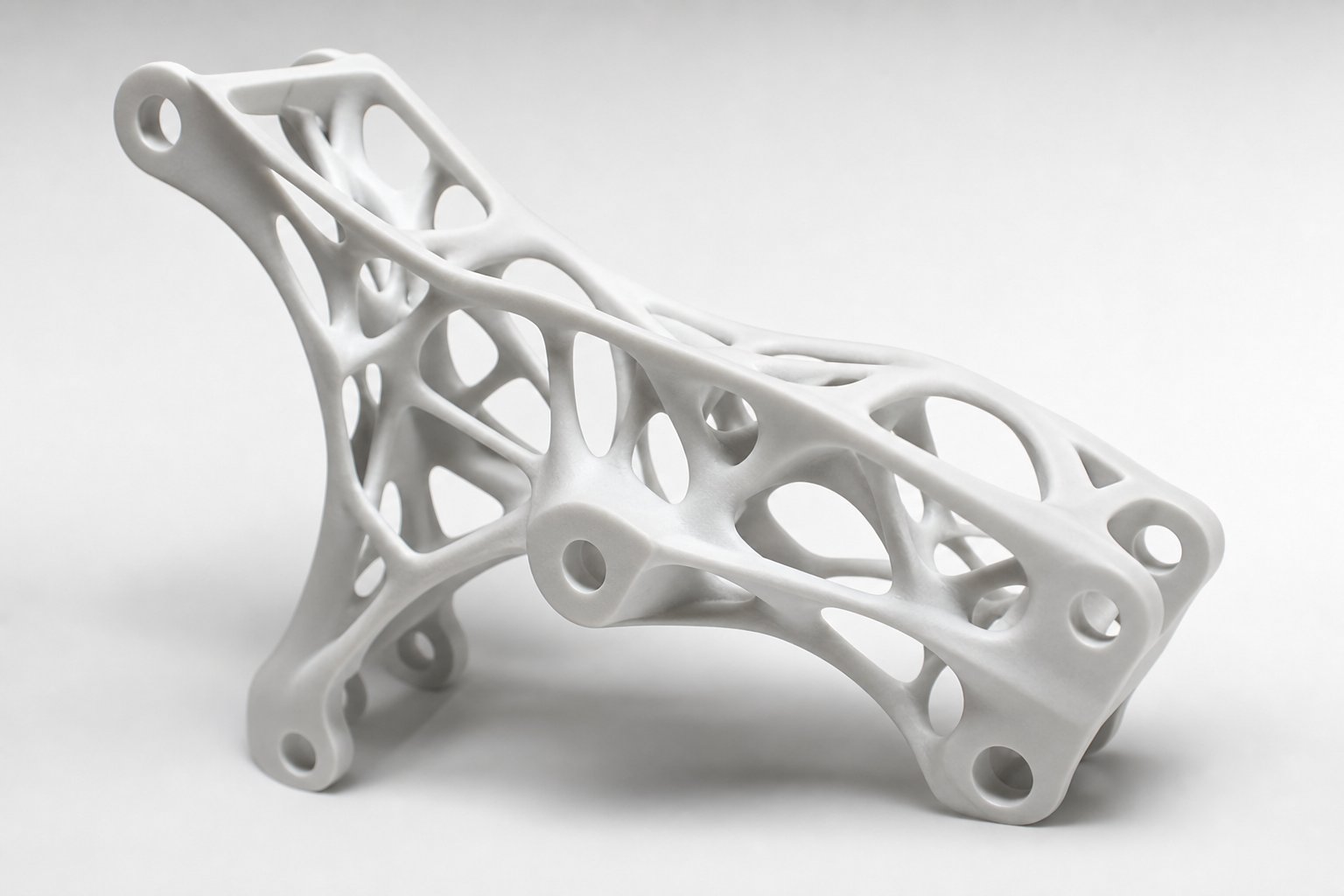
Topology optimization is a method based on computational mechanics. Under the premise of given loads, constraints and materials, it uses an iterative algorithm to find the optimal distribution area of materials. At its core, it is about identifying which materials within the design space can be removed without affecting strength, resulting in a structural form that is lightweight but retains load-bearing capacity. The optimization results usually present an organic form similar to natural bones. This form is extremely difficult to process in traditional manufacturing, and 3D printing can perfectly achieve it.
Introduction of manufacturing constraints
Directly importing topology optimization results into printing requires solving the geometry cleaning problem. The mesh generated by the optimization cloud map needs to be converted into a printable CAD entity. During this process, a draft angle needs to be added to facilitate demoulding (during subsequent machining), rounded corners and chamfers to reduce stress concentration, and a minimum wall thickness to ensure printing quality. For FDM printing, it is recommended to set the fiber texture along the direction of stress, while for SLA printing, additional support areas need to be added to the overhang structure.
Verification and iteration
Structural verification must be carried out after optimization. It is recommended to use finite element analysis software to perform static and modal analysis on the optimized CAD model before printing. After printing out the sample, conduct an actual load test, feed the test results back into the model to correct the load boundary conditions, and optimize through two or three cycles to converge to the lightest structure that meets the strength requirements.
Submit a model, drawing, image or written notes. Engineers will review material, process, finishing and delivery based on actual use.