Introduction: Seasonal Fluctuations Are the Norm in 3D Printing Services
Demand in the 3D printing service industry shows clear seasonal fluctuation patterns. The fourth quarter of each year (Q4) is usually the peak demand season, because companies need to complete project deliveries and launch new products before year-end; the first quarter (Q1) is relatively slow, affected by the Lunar New Year holiday and corporate budget resets. In addition, certain industries have their own seasonality: consumer electronics sees a surge in demand three months before new product launches, the automotive industry is busy before auto shows, and the education sector concentrates demand before the start of a semester. Faced with these fluctuations, how to manage capacity flexibility—avoiding wasted resources during low periods while not missing business opportunities during peak periods—is a challenge every 3D printing service provider must solve.
Demand Forecasting: Data-Driven Trend Analysis
Accurate demand forecasting is the foundation of capacity management. Professional service providers should build a historical demand database and record demand data by month, industry, process type, part complexity, and other dimensions. Through time-series analysis, annual seasonality, monthly volatility, and long-term growth trends can be identified. Beyond the basic forecast, external information such as macroeconomic indicators (for example, manufacturing PMI), industry-specific events (such as major trade shows and new product launch cycles), and customer project plans should also be used for adjustments. Forecasts should not be a single fixed number, but a probability range, such as “there is an 80% probability that December demand will fall between X and Y units.” This type of interval forecast is more effective in guiding flexible capacity allocation decisions.
A Three-Layer Architecture for Flexible Capacity Allocation
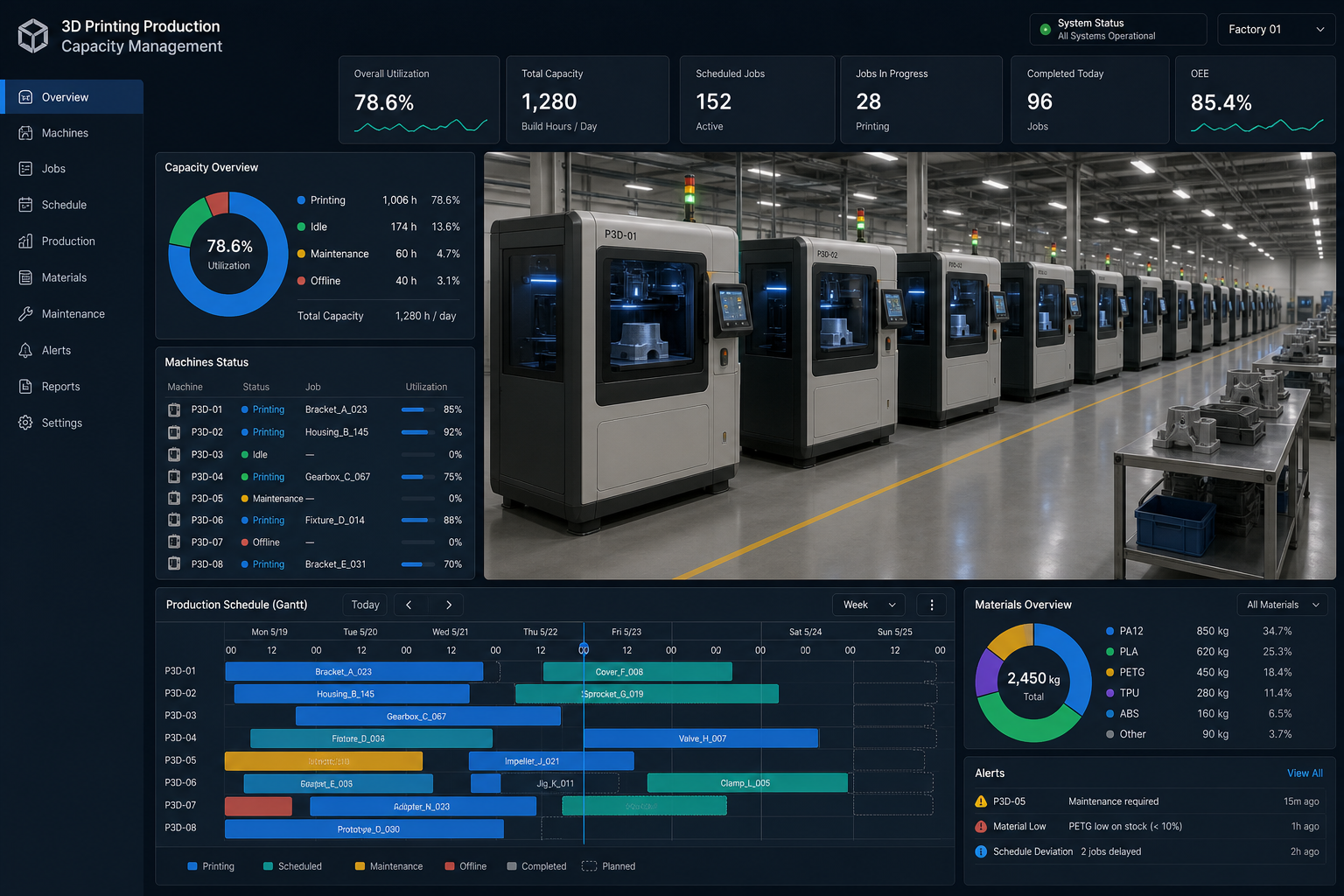
Capacity allocation for dealing with demand fluctuations should adopt a three-layer architecture: base capacity, flexible capacity, and outsourced capacity. Base capacity consists of equipment that operates steadily throughout the year, typically configured at 70% of annual average demand to ensure basic operations even during low seasons. Flexible capacity refers to capacity that can be rapidly increased through overtime, equipment rental, temporary workers, and similar measures to handle predictable demand peaks. Outsourced capacity is a collaboration network established with partners to divert part of the orders during extreme peak periods. This three-layer architecture controls fixed costs while preserving flexibility in response to fluctuations. The key is that the switching mechanism between layers must be fast and smooth to avoid response delays that lead to lost business opportunities.
Equipment Portfolio Strategy: Balancing Multi-Purpose and Dedicated Machines
Equipment used in different process types has different abilities to adapt to demand fluctuations. SLA machines are highly versatile and can handle a wide range of needs, from precision parts to large appearance components, making them suitable as base capacity. SLS machines are well suited to small- and medium-batch production; during peak demand they can run continuously, making them a good choice for flexible capacity. SLM metal machines require high investment and long cycle times, so they are better suited to long-term, stable specialized orders and should not be adjusted frequently. In equipment portfolio strategy, a certain proportion of general-purpose equipment should be maintained (recommended at more than 60%) to address uncertainty in demand structure. At the same time, through equipment upgrades and process improvements, the range of applications and production efficiency of each machine should continuously be improved to fundamentally strengthen capacity flexibility.
Workforce Scheduling Optimization: Flexible Staffing and Skills Matrices
Equipment requires operators, so capacity flexibility also depends on flexible workforce allocation. Professional service providers should establish a skills matrix to record each employee's machine operation capabilities, post-processing skills, process knowledge, and more, forming a talent ladder of “specialized yet versatile” personnel. During low-demand periods, training and skill development should be arranged; during peak periods, capacity can be released through optimized scheduling such as two-shift operations and weekend overtime. For repetitive post-processing work, a pool of temporary workers can be built to quickly supplement labor during peak times. The key to flexible staffing is maintaining the stability of the core team while improving overall efficiency through training and reducing reliance on temporary labor.
Outsourcing Collaboration Network: Building a Reliable Capacity Buffer
When internal capacity reaches its limit, an outsourcing collaboration network becomes the final capacity buffer. Building such a network is not as simple as “finding a few print shops”; it requires systematic partner management. First, potential partners must be evaluated for capabilities: equipment types, process quality, quality systems, delivery performance, confidentiality capabilities, and more. Second, a cooperation mechanism must be established, including quotation processes, file transfer methods, quality standards, acceptance procedures, and settlement methods. Finally, relationships must be maintained regularly through sharing technology trends, exchanging project experience, and jointly solving difficult problems. A reliable collaboration network is not only a capacity buffer, but also a window for learning new technologies and expanding service capabilities.
Submit a model, drawing, image or written notes. Engineers will review material, process, finishing and delivery based on actual use.