Introduction: Data Security Is the Foundation of Trust in 3D Printing Services
3D model files are the core carriers of a customer’s intellectual property and contain all the detailed information of a product design. Once leaked, they may allow competitors to copy products, counterfeit designs, or even trigger legal disputes. For 3D printing service providers, which handle large volumes of confidential client files every day, data security is not only a technical issue, but also a matter of trust and law. A complete data security system is a prerequisite for earning customer trust and securing premium orders. In particular, when serving customers in sensitive industries such as aerospace, medical devices, and defense, data security capability is often a mandatory requirement for supplier qualification. Building a systematic data security framework has become one of the core competitive strengths of professional 3D printing service providers.
File Encryption: End-to-End Protection from Transmission to Storage
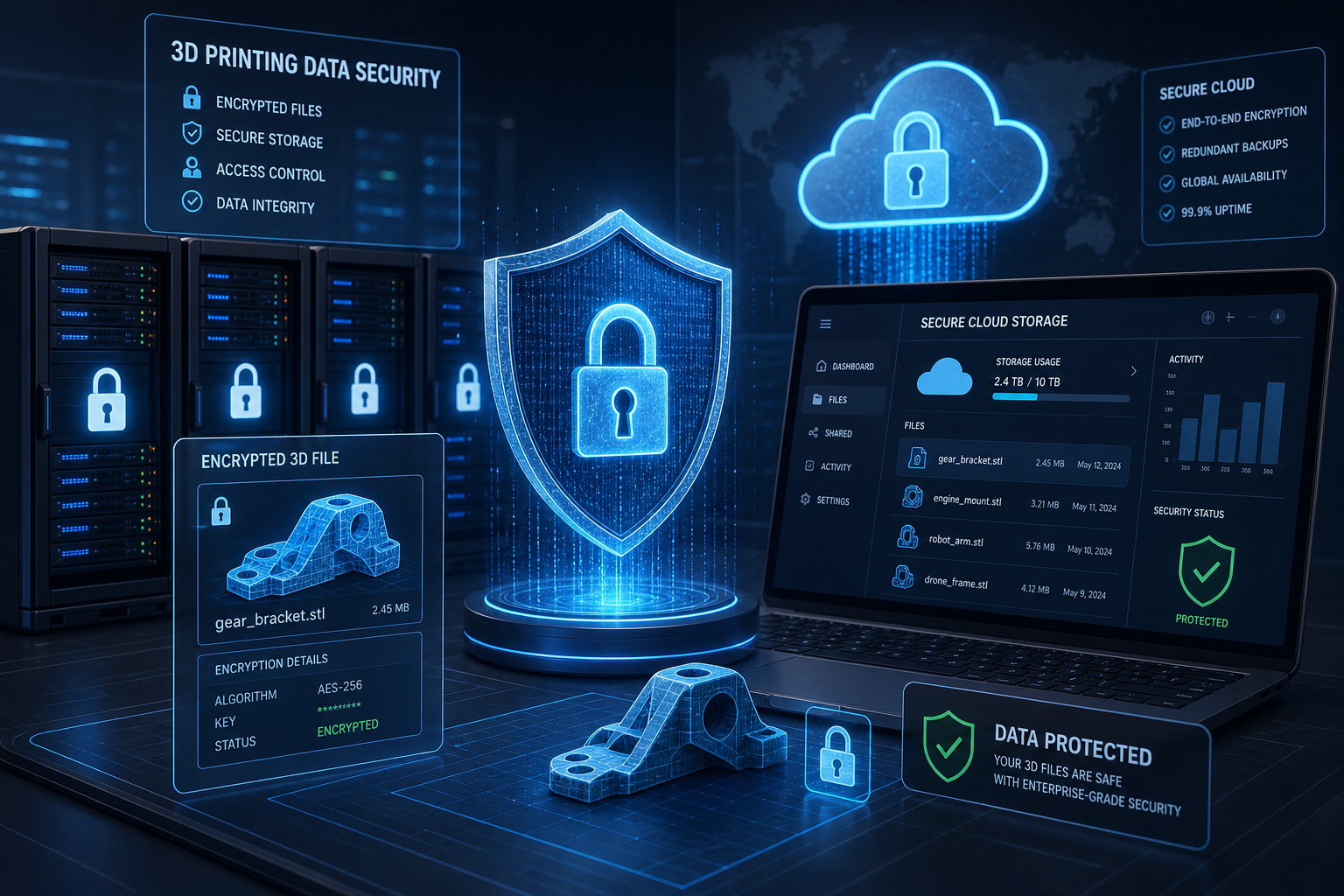
File encryption is the first line of defense in data security. During file transfer, HTTPS should be used to ensure the safety of uploads. For especially sensitive files, PGP encryption or dedicated encryption tools can also be used for end-to-end protection. In file storage, strong encryption algorithms such as AES-256 should be applied to model files, ensuring that even if storage devices are stolen, the data cannot be read. In file access control, permission management policies should be implemented: employees at different levels should only be able to access the minimum set of files required for their work, and all file access activities should be logged and audited. Encryption is not a one-time setting; it is an ongoing process that requires regular evaluation of encryption strength, updates to encryption algorithms, and rotation of encryption keys. Only by establishing an end-to-end protection system can customer files truly be secured.
Access Control: Least Privilege and Multi-Factor Authentication
The core principle of access control is "least privilege": each employee should only be granted the minimum permissions necessary to complete their work. For example, customer service staff may only view basic order information and cannot download model files; printing operators may only download files waiting to be printed and cannot view historical projects; engineers may access project files but cannot bulk export customer data. In addition to permission management, multi-factor authentication (MFA) should also be implemented: employees logging into the system should need not only a password, but also a mobile verification code or hardware token. For especially sensitive operations, such as bulk data export or permission changes, additional approval workflows should be required. Through strict access control, the risk of data leakage caused by insiders can be minimized, while also providing a complete audit trail for post-incident review.
Storage Management: Lifecycle and Backup Strategies
Storage management for 3D model files must balance security and accessibility. For ongoing projects, files need to be quickly accessible and stored in a high-performance online storage system. For completed projects, files can be migrated to lower-cost cold storage systems, but they should still be retained for a certain period of time, usually 3 to 5 years, in case customers need to query them. For files that exceed the retention period, they should be thoroughly deleted in accordance with data security standards (through multiple overwrites or physical destruction) to avoid the risk of data residue. Backup strategy is equally important: critical data should have at least three copies stored in different physical locations, with at least one copy kept offline. The backup recovery process should be tested regularly to ensure rapid restoration in the event of data loss. Effective storage management not only protects data security, but also improves service response efficiency.
Nondisclosure Agreements: A Legal Barrier of Protection
Beyond technical measures, a nondisclosure agreement (NDA) is the legal barrier that protects a customer’s intellectual property. The NDA should clearly define the scope of confidential information, including but not limited to 3D models, technical drawings, and process parameters; confidentiality obligations, such as not copying, distributing, or using the information for other purposes; the confidentiality period, usually 3 to 5 years after project completion; and liability for breach, including liquidated damages, compensation scope, and dispute resolution methods. For especially sensitive customers, customized NDAs can be signed to add stricter protection clauses. An NDA is not only a legal document, but also a signal of professionalism sent to the customer. When signing the NDA, the service provider should proactively explain its data security measures so the customer understands that their intellectual property will be protected comprehensively. Only with both legal and technical safeguards can customer trust truly be established.
Employee Training: Human-Factor Management for Data Security
The greatest risks to data security often come from human factors: employees unintentionally leaking passwords, discussing sensitive matters in public places...
Submit a model, drawing, image or written notes. Engineers will review material, process, finishing and delivery based on actual use.